
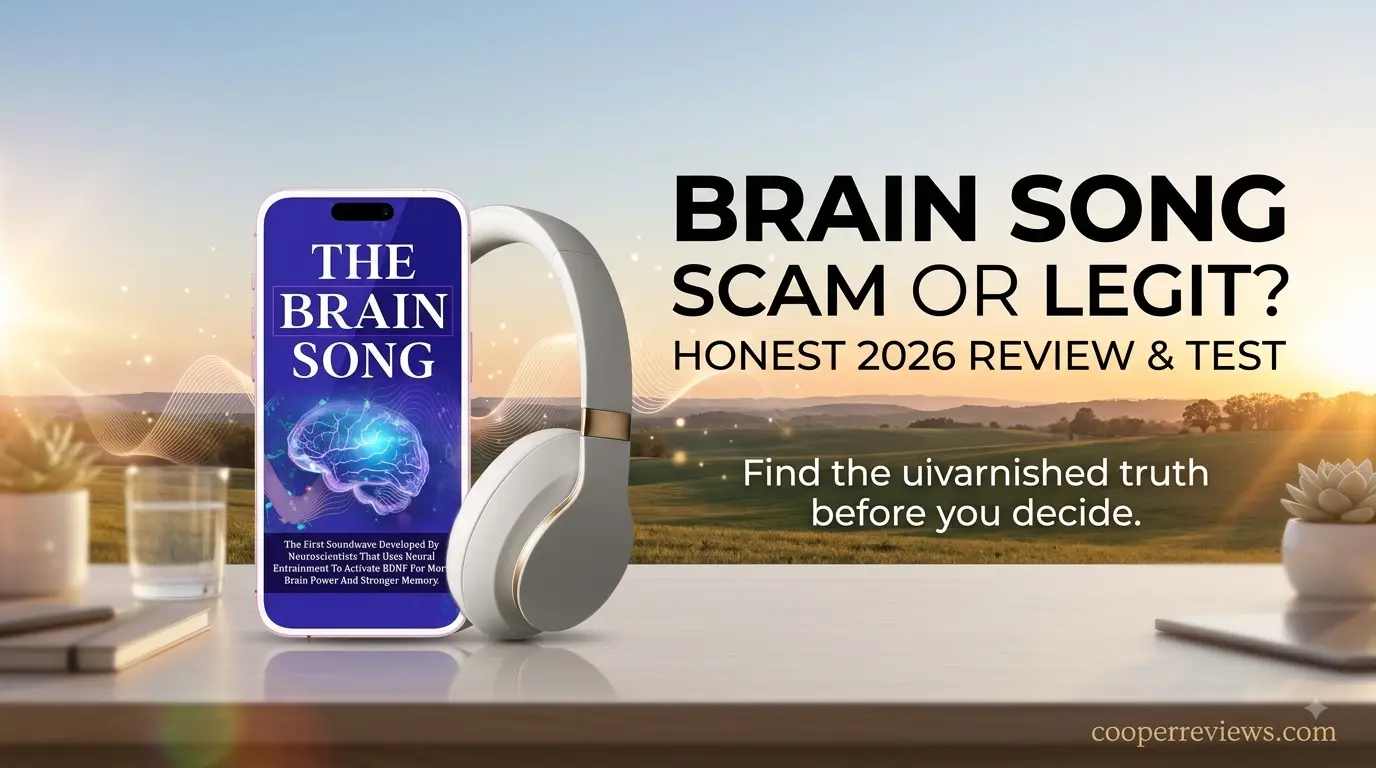
Brain Song Scam or Legit? An Honest 2026 Guide Before You Buy
Brain Song Scam or Legit? The Short Answer
If you’re searching “Brain Song scam or legit”, I understand why. Products promising better memory, sharper focus, or less brain fog deserve more than a persuasive sales page before you spend your money.
After looking at what Brain Song actually is, the claims made around it, the available research on auditory stimulation, and my own experience, I wouldn’t automatically label Brain Song a scam—but I also wouldn’t describe every marketing claim as scientifically established fact.
That distinction matters.
Brain Song is a digital audio program marketed around soundwave technology, brainwave entrainment, memory, focus, and BDNF. Its official website currently describes it as a 17-minute audio program and lists a $39 one-time price.
The more useful question isn’t simply “Is Brain Song legit?”
It’s:
Does the product deliver enough value for the average person to justify buying it?
That’s what I’ll examine here.
My Verdict: Is Brain Song a Scam or Legit?
My current view is that Brain Song is a legitimate digital audio product, but the evidence for its specific advertised cognitive benefits should be treated cautiously.
That’s an important difference between legitimate product and scientifically proven outcome.
Brain Song exists as a purchasable digital audio program, and its official marketing explains the intended mechanism. But I would not use the existence of neuroscience research about music, gamma stimulation, BDNF, or auditory entrainment as proof that this particular commercial recording produces the same outcomes.
That’s where many online reviews become misleading.
A study about a particular frequency isn’t automatically a study about Brain Song.
A study about music isn’t automatically evidence for Brain Song.
And an individual’s positive experience isn’t the same thing as a randomized controlled trial.
The Federal Trade Commission makes a similar distinction when evaluating health-related advertising: objective health claims need appropriate substantiation, and individual testimonials don’t substitute for scientific evidence.
So my answer is:
Legitimate product? Yes.
Guaranteed memory enhancer? No.
Worth considering if you understand the limitations? Potentially.
“Read my full Brain Song review before making your decision.”
What Exactly Is Brain Song?
Brain Song is a digital audio program designed around soundwave and brainwave-entrainment concepts rather than a pill, supplement, or conventional brain-training app.
According to its official website, Brain Song is a 17-minute audio program intended to support memory, focus, and cognitive performance. Its marketing connects the program with BDNF and gamma-wave activity.
The attraction is obvious, especially for busy adults.
Instead of remembering another supplement, learning a complicated meditation protocol, or spending 30 minutes solving brain-training games, the proposed routine is simply to listen.
That simplicity is one of the product’s strongest selling points.
But simplicity doesn’t automatically equal effectiveness.
The relevant scientific question is whether auditory stimulation can meaningfully influence attention, arousal, memory, or other cognitive processes.
And here, the research becomes much more interesting.
What Does the Science Say About Sound and Memory?
Research supports the idea that music and auditory stimulation can influence cognitive and emotional states, but the evidence is mixed and doesn’t establish that every commercial brainwave audio program improves memory.
A 2024 systematic review examined 31 studies involving music, ambient noise, white noise, and binaural beats. The authors found that evidence connecting auditory stimulation with autonomic arousal and cognitive performance was mixed or insufficient to draw firm conclusions.
That’s exactly the kind of nuance I think consumers need.
There is promising research.
There are also limitations.
For example, music can be strongly connected with autobiographical memory. A systematic review found that familiar music can evoke memories relatively quickly and with relatively little retrieval effort.
Separate research has investigated music-based interventions and cognitive outcomes in older adults. A recent systematic review and meta-analysis of randomized controlled trials reported improvements in global cognition, memory, and executive function among cognitively normal adults aged 60 and older receiving music-based interventions.
But notice the wording:
Music-based interventions ≠ Brain Song.
That’s an important distinction.
What Is BDNF and Why Does Everyone Mention It?
BDNF, or brain-derived neurotrophic factor, is a protein involved in neuronal survival, growth, and plasticity, making it relevant to research into learning and memory.
It’s sometimes described online as the brain’s “fertilizer,” which is an easy metaphor to understand.
But marketing language can make the science sound much more straightforward than it actually is.
Brain Song’s marketing specifically says the program is designed to stimulate BDNF through soundwave technology.
That’s a product claim, not something I would present as independently established evidence that listening to the recording causes a clinically meaningful increase in BDNF.
This distinction is especially important if you’re researching Brain Song because of age-related memory concerns.
The National Institute on Aging explains that occasional forgetfulness can happen with normal aging, but significant changes that interfere with everyday activities deserve medical attention.
So an audio program should be viewed as a wellness tool—not as a replacement for professional evaluation.
What About 40 Hz Gamma Waves?
Gamma-frequency activity is an active area of neuroscience research, but promising research doesn’t mean a consumer audio product has been proven to produce a specific clinical outcome.
Brain Song’s marketing emphasizes gamma-wave entrainment.
Researchers have indeed studied auditory gamma stimulation.
A 2025 systematic review covering 62 studies found that auditory gamma stimulation is promising as a non-invasive approach, but outcomes varied considerably between studies and individuals. The researchers also noted that animal findings don’t necessarily translate consistently to humans.
That’s a much more useful way to look at the subject than:
“40 Hz fixes memory.”
It doesn’t.
The science is more complicated.
And that’s precisely why I wouldn’t buy Brain Song because someone told me a particular frequency is guaranteed to “activate” my memory.
I’d buy it only if I was comfortable treating it as an experimental wellness tool with uncertain individual results.
“Before you decide, take two minutes to check out my honest Brain Song breakdown.”
My Experience With Brain Song
My experience with Brain Song was positive, particularly because the routine was simple enough to use consistently.
I originally came across Brain Song through search while looking for ways to support memory.
I wasn’t looking for a miracle.
I wanted something practical that could fit into an ordinary day without adding another complicated supplement stack or elaborate routine.
The short listening format appealed to me.
I found that using an audio routine created a clear transition between “I’m distracted” and “I’m going to focus now.”
That’s important because sometimes the benefit of a wellness routine isn’t as dramatic as the marketing suggests.
It can simply become a behavioral cue.
Put on headphones.
Sit down.
Remove distractions.
Give yourself a short period of uninterrupted attention.
That’s not necessarily evidence that Brain Song has permanently changed anything in the brain.
But it can still be useful.
What I noticed
My experience was most positive around:
- Getting into a focused state
- Creating a consistent morning routine
- Feeling mentally settled before demanding work
- Taking a short intentional break from notifications
- Supporting my overall focus habits
I wouldn’t claim that Brain Song single-handedly transformed my memory.
That wouldn’t be an honest conclusion.
Sleep, stress, exercise, nutrition, workload, hydration, and expectations can all influence how mentally sharp you feel.
“I tested Brain Song inside out—here’s what you should know before buying.”
Brain Song Scam or Legit? 7 Things I Would Check Before Buying
If you’re considering purchasing, here’s my practical checklist.
1. Is there a real product?
Yes. Brain Song is presented as a digital audio program on its official website.
2. Is it a medication?
No.
It’s an audio-based digital product rather than an FDA-approved drug.
3. Does neuroscience research exist around auditory stimulation?
Yes.
There is legitimate research into music, auditory stimulation, binaural beats, gamma activity, and cognition. But findings are not uniformly positive or directly applicable to Brain Song.
4. Does that prove Brain Song works?
No.
This is probably the most important point in this entire article.
Research into a mechanism doesn’t automatically validate a specific commercial product.
5. Can individual experiences be meaningful?
Yes—but they remain individual experiences.
If someone says an audio routine helps them concentrate, that can be useful information. It simply shouldn’t be presented as clinical evidence.
6. Should you expect instant results?
I wouldn’t.
If you’re experimenting with an audio routine, consistency and context matter.
7. Should Brain Song replace medical care?
Absolutely not.
If you’re experiencing significant or rapidly changing memory problems, speak with a qualified healthcare professional. The National Institute on Aging specifically recommends discussing concerning memory changes with a doctor.
Brain Song Pros and Cons
| Potential advantages | Potential drawbacks |
|---|---|
| Simple audio-based routine | Evidence for the specific product is limited |
| No supplement ingredients to swallow | Results can vary considerably |
| Short daily listening format | Marketing claims require careful interpretation |
| Convenient for home use | Doesn’t replace healthy lifestyle habits |
| May fit easily into a morning routine | Not a treatment for cognitive disorders |
| One-time digital purchase according to current marketing | Price and terms can change |
For me, the biggest advantage is convenience.
The biggest limitation is the gap between research on related neuroscience and proof of this specific product’s effectiveness.
That’s a gap every responsible review should acknowledge.
Brain Song vs. Supplements: Which Makes More Sense?
Brain Song and supplements solve different problems, and neither should automatically be considered superior.
Supplements require you to consider ingredients, dosage, interactions, quality control, and your individual health circumstances.
Brain Song doesn’t involve ingesting anything.
That doesn’t make it automatically more effective.
It simply makes the risk-and-benefit equation different.
If you’re already taking medications or supplements, it’s particularly important to discuss changes with your healthcare professional rather than assuming a “natural” product is automatically appropriate.
And when evaluating health claims, the FTC emphasizes that advertisers need appropriate evidence for objective claims.
That’s why I prefer a cautious approach:
Start with the fundamentals first.
Sleep.
Exercise.
Nutrition.
Stress management.
Social connection.
Then consider optional tools that complement those foundations.
Who Might Consider Brain Song?
I think Brain Song is more interesting for people who:
- Prefer audio-based wellness routines
- Want a simple daily focus ritual
- Don’t want another supplement
- Enjoy experimenting with non-drug approaches
- Have realistic expectations
- Are willing to evaluate their own response over time
For a woman in her late 40s, 50s, or beyond who is noticing occasional forgetfulness but otherwise feels well, that might make Brain Song an interesting experiment.
But there’s an important caveat.
If you’re repeatedly forgetting appointments, becoming lost in familiar places, struggling with everyday tasks, or experiencing significant changes in thinking, don’t attempt to solve the problem solely with an audio product. The NIA recommends discussing concerning changes with a healthcare professional.
Who Should Probably Skip It?
I’d be cautious if you’re expecting:
- A cure for memory loss
- Guaranteed results
- A replacement for medical evaluation
- A substitute for sleep or exercise
- Proof that your memory problems are caused by low BDNF
- A treatment for Alzheimer’s disease or dementia
Those expectations go far beyond what the evidence can responsibly support.
The FDA also warns consumers to be skeptical of health products making unsupported claims about treating or curing medical conditions.
What I Would Do Before Spending $39
If you’re on the fence, don’t let a dramatic headline make the decision for you.
I’d ask five questions:
1. What exactly am I trying to improve?
Memory? Focus? Stress? Productivity?
2. What evidence supports the product itself?
Not just the general science behind sound.
3. What am I realistically expecting?
A subtle improvement in focus is very different from reversing cognitive decline.
4. Am I already doing the basics?
If you’re sleeping four hours a night, an audio track probably shouldn’t be your first priority.
5. Have I read an independent review?
This is where I recommend looking beyond the sales page.
Read My Full Brain Song Review Before You Decide
If you’re still wondering “Brain Song scam or legit?”, I’d suggest reading a detailed review before making a purchase rather than relying on a single headline or testimonial.
I put together a separate Brain Song in-depth review for 2026 where I go deeper into the experience, pricing, how the program is supposed to work, potential advantages and limitations, and who I think should—or shouldn’t—consider it.
My recommendation: read the full review first, then decide whether the product fits your expectations and budget.
That’s a much better approach than buying something because an advertisement promises that you’ll suddenly become dramatically sharper.
Frequently Asked Questions
Is Brain Song a scam?
I wouldn’t call Brain Song a scam based solely on the available information. It is sold as a digital audio product with a stated purpose and pricing. However, some of its stronger cognitive claims should be viewed cautiously because research on related auditory and gamma stimulation does not automatically prove that this specific recording produces those outcomes.
Does Brain Song really work?
It may help some people with focus or relaxation, but individual results vary. My experience was positive, particularly as a structured listening routine. However, there isn’t enough evidence for me to claim that Brain Song reliably improves memory for everyone or produces a clinically meaningful cognitive effect.
Is Brain Song scientifically proven?
The underlying areas of research are real, but that isn’t the same as proving Brain Song itself. Researchers have studied music, auditory stimulation, binaural beats, gamma activity, and cognition. A 2024 systematic review, however, described evidence connecting auditory stimulation with cognitive performance as mixed or insufficient for firm conclusions.
What is Brain Song used for?
Brain Song is marketed as a short audio routine for supporting memory, focus, and cognitive performance. The official website describes it as a 17-minute program using soundwave technology and brainwave entrainment concepts.
Is Brain Song safe?
As an audio program, it doesn’t involve ingesting an active drug or supplement ingredient. However, individual sensitivity to sound varies. If listening causes discomfort or unusual symptoms, stop using it and seek appropriate professional advice. People with specific neurological or medical conditions should discuss new wellness interventions with a healthcare professional.
Is Brain Song worth the money?
That depends on what you’re expecting. If you want a simple audio-based focus routine and have realistic expectations, it may be worth exploring. If you’re expecting a scientifically established treatment for memory loss or cognitive disease, I would not recommend purchasing it for that purpose.
Final Verdict: Brain Song Scam or Legit?
After separating the marketing from the science, my conclusion is fairly straightforward.
Brain Song appears to be a legitimate digital audio product, but “legit product” should not be confused with “proven memory treatment.”
There is legitimate scientific interest in auditory stimulation, music, brain rhythms, neuroplasticity, and gamma activity. Research also suggests that music can interact with memory and cognitive processes in interesting ways.
At the same time, the evidence surrounding auditory stimulation remains nuanced, and studies of related mechanisms shouldn’t automatically be presented as proof that Brain Song produces a particular result.
My own experience was positive, especially because the routine was easy to incorporate into my day.
But I’d rather give you an honest “this may be worth trying” than a dramatic promise that can’t be supported.
If you’re curious about the product, read my full Brain Song review before making your decision. I break down the product from a buyer’s perspective so you can decide with realistic expectations.
Brain Song scam or legit? My answer: legitimate product, interesting concept, promising but not definitive evidence—and worth evaluating carefully rather than blindly believing either the hype or the criticism.
“I broke down the pros, cons, and realistic results of Brain Song right here before you commit.”
Sources & Further Reading
For readers who want to investigate the science rather than simply take my word for it:
- Federal Trade Commission — Health Products Compliance Guidance
- National Institute on Aging — Memory Problems, Forgetfulness, and Aging
- PubMed — Systematic Review of Music and Auditory Stimulation
- PubMed — Auditory Gamma Stimulation Systematic Review
- PubMed — Music-Evoked Autobiographical Memories Review
- Brain Song Official Website
Affiliate disclosure: I may earn a commission if you purchase Brain Song through my affiliate link. This does not change the price you pay or my assessment of the product. I have intentionally included limitations and scientific uncertainty so you can make an informed decision.