
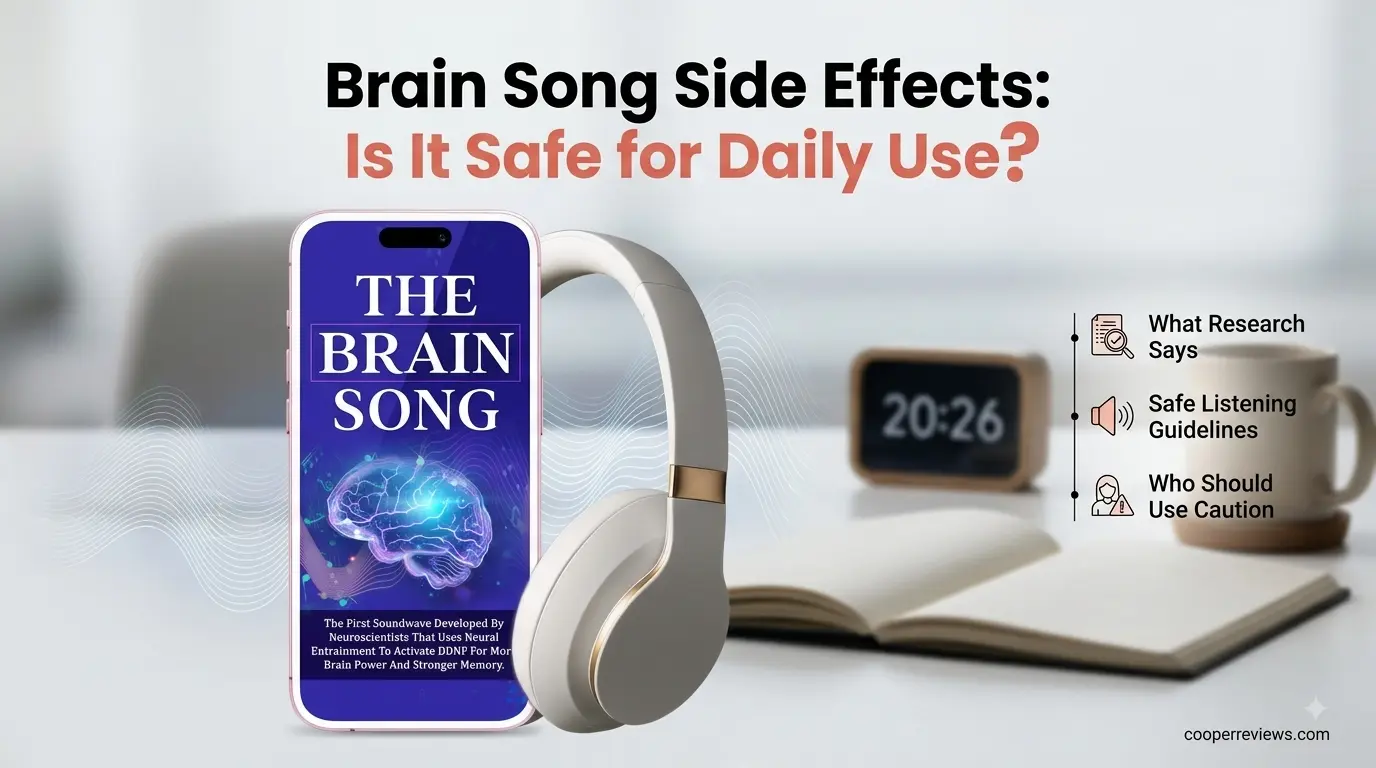
Brain Song Side Effects: Is It Safe to Use Daily?
If you’re considering Brain Song because your memory doesn’t feel as sharp as it used to, one question deserves an honest answer before anything else: Are there Brain Song side effects, and is listening every day actually safe?
I think that’s a much better question than simply asking whether an audio program “works.”
Brain Song is a digital audio program marketed around memory, focus, mental clarity, and sound-based brainwave stimulation. Current product pages describe a short daily listening session, with some versions describing approximately 12–17 minutes and promoting gamma-frequency audio.
But here’s the important distinction: research on particular forms of auditory stimulation is not the same thing as proof that every commercial Brain Song track produces the same effects or has zero risks.
So I looked at the available evidence, the product information, and the practical safety considerations that matter most—especially if you’re a woman in your 40s, 50s, or beyond who simply wants to support memory without adding another complicated routine.
Quick Answer: Does Brain Song Have Side Effects?
Brain Song appears to be a non-invasive audio product, but it would be inaccurate to promise that it has zero possible side effects for everyone.
Research into 40 Hz auditory stimulation has generally found good short-term tolerability, although some participants have reported issues such as ear discomfort, jaw discomfort, or other mild symptoms. A 2025 prospective study of 28 adults aged 65+ found no major safety concerns over 28 days, but six participants reported 12 adverse events, including six considered related to the intervention.
That’s why I wouldn’t approach Brain Song with either extreme:
- ❌ “It’s dangerous.”
- ❌ “It has absolutely no side effects.”
- ✅ “It’s an audio-based wellness product, and sensible listening habits matter.”
Your response can also depend on volume, headphones, listening duration, individual sensitivity, and the exact audio technology being used.
What Is Brain Song and How Does It Work?
Brain Song is a digital audio program designed to support memory, concentration, and mental clarity through structured sound stimulation. Product pages currently describe a short daily session and sound frequencies intended to encourage particular patterns of brain activity.
The product is marketed primarily toward people who want something simpler than supplements, complicated cognitive-training routines, or another app requiring hours of daily commitment.
The basic concept is straightforward:
Put on headphones → listen to the programmed audio → make it part of a consistent routine.
Some Brain Song websites describe gamma-wave frequencies and neural entrainment as central to the program.
That concept isn’t completely invented.
Researchers have genuinely studied gamma-frequency auditory and audiovisual stimulation. A 2026 review describes 40 Hz gamma oscillations as relevant to attention and memory research, while emphasizing that the clinical applications are still developing.
However, there’s an important scientific boundary:
Research on 40 Hz stimulation does not automatically establish that a particular commercial audio program will improve memory in every listener.
That’s the distinction I’d want any buyer to understand.
Brain Song Side Effects: What Should You Actually Watch For?
The most practical concerns are usually listening-related rather than the kind of systemic side effects associated with medication.
Because Brain Song is an audio product rather than a pill or injectable treatment, the safety conversation is different.
Here are the things I’d pay attention to.
1. Ear discomfort
If headphones become uncomfortable, don’t try to “push through” it.
In the 2025 study of 40 Hz amplitude-modulated auditory stimulation in older adults, ear discomfort was among the reported adverse events. The events were described as mild or moderate.
Your ears shouldn’t hurt simply because you’re trying to complete a wellness routine.
2. Listening at excessive volume
This is probably the most obvious precaution—and one that’s easy to overlook.
The World Health Organization recommends keeping personal listening volume below about 60% of maximum and taking breaks from prolonged headphone use.
You don’t need loud audio to make a listening session worthwhile.
Comfortable volume is the goal—not maximum volume.
3. Headache or sensory discomfort
Some people are more sensitive to repetitive or unusual sounds than others.
If an audio session produces a headache, nausea, dizziness, agitation, or unusual discomfort, stop the session and see whether the symptom resolves.
That doesn’t necessarily mean Brain Song is “bad.” It means your individual response matters more than a marketing claim.
4. Tinnitus or ringing in the ears
This deserves particular attention.
A 2025 systematic review and meta-analysis of gamma-frequency auditory/visual stimulation found no significant increase in overall adverse events, but it did identify a potential increase in tinnitus risk in the pooled evidence. The authors also emphasized that larger, better-designed studies are needed.
So if you already experience tinnitus or notice new ringing after listening, I wouldn’t ignore it.
Stop listening and consider discussing it with an appropriate healthcare professional.
5. Overuse
More isn’t automatically better.
If a program recommends a short daily session, there’s little reason to turn it into an hours-long headphone marathon.
A simple routine is more sensible:
short session → comfortable volume → consistent schedule → monitor your response.
Is Brain Song Safe to Use Every Day?
Available research on certain forms of daily 40 Hz auditory stimulation suggests that short-term daily use can be well tolerated, but that doesn’t establish unlimited safety for every Brain Song user or long-term use.
This is where nuance matters.
The 2025 study I mentioned earlier had participants use 40 Hz amplitude-modulated auditory stimulation daily for 28 days. The researchers reported high adherence and no worsening of cognitive function, depression scores, or hearing thresholds during the study.
That’s encouraging.
But it was:
- A small study
- Open-label
- Only 28 participants
- A specific auditory-stimulation protocol
- Not necessarily the same audio used by Brain Song
So I would not turn that study into the statement “Brain Song has been proven completely safe.”
That’s not what the research says.
Instead, I’d describe the evidence as promising but limited and product-specific evidence still matters.
What Does 40 Hz Gamma Research Actually Tell Us?
40 Hz gamma stimulation is a legitimate area of neuroscience research, but researchers are still working out exactly when, how, and for whom it produces meaningful cognitive benefits.
Gamma oscillations are associated with processes involved in attention, information integration, and memory.
Researchers have investigated whether rhythmic stimulation can influence these brain rhythms through a phenomenon commonly described as neural entrainment.
A review published in Frontiers in Aging Neuroscience discusses 40 Hz audiovisual stimulation and reports effects on neural oscillations and synaptic plasticity in experimental and clinical research, while also noting that the precise mechanisms and clinical applications remain uncertain.
That’s fascinating—but it isn’t the same as saying:
“Listen to this particular track and your memory will definitely improve.”
In fact, a 2025 systematic review and meta-analysis involving gamma-frequency auditory and visual stimulation in Alzheimer’s disease and mild cognitive impairment found no statistically significant improvement in cognitive function despite some structural brain findings.
That’s exactly why I prefer realistic expectations over miracle claims.
Could Brain Song Cause Dizziness or Headaches?
It’s possible for an individual to experience discomfort from an audio stimulus, although that doesn’t mean such symptoms are expected for everyone.
People react differently to sounds, headphones, repetitive tones, and changes in sensory stimulation.
If you notice:
- Headache
- Dizziness
- Nausea
- Ear pressure
- Ringing
- Anxiety or unusual agitation
- Difficulty tolerating the sound
I’d simply stop the session.
Don’t assume you need to “adapt” to discomfort.
If symptoms persist after stopping, seek medical advice rather than assuming the audio is the cause.
How to Use Brain Song More Safely
If you’re going to try Brain Song, I’d keep the routine deliberately boring.
That’s actually a good thing.
My practical checklist
1. Start with comfortable volume.
Don’t blast the audio.
WHO recommends keeping headphone volume below 60% of maximum and taking listening breaks.
2. Use good-quality headphones.
You don’t necessarily need expensive equipment. Comfort matters more than having the fanciest headphones.
3. Listen somewhere quiet.
A calm environment makes it easier to determine whether the audio itself feels comfortable.
4. Don’t listen while driving.
If you’re using headphones, your attention should be directed toward the session—not traffic or other hazards.
5. Don’t extend the session unnecessarily.
Follow the program’s instructions rather than assuming longer equals better.
6. Track Your Response
Instead of relying only on how you feel after listening, keep a simple daily record. This can help you notice patterns over time and distinguish a consistent change from a one-day fluctuation.
Rate each category from 1–10, where 1 is very poor and 10 is excellent.
| What to Track | Before Listening | After Listening | Notes |
|---|---|---|---|
| Mental clarity | ___ / 10 | ___ / 10 | Did your thoughts feel clearer? |
| Focus | ___ / 10 | ___ / 10 | Was it easier to stay on one task? |
| Head comfort | ___ / 10 | ___ / 10 | Any pressure, discomfort, or headache? |
| Energy | ___ / 10 | ___ / 10 | Did you feel alert or tired? |
| Irritability | ___ / 10 | ___ / 10 | Did you feel calm, neutral, or irritated? |
| Memory recall | ___ / 10 | ___ / 10 | How easily did you recall information? |
| Listening comfort | ___ / 10 | ___ / 10 | Was the audio comfortable to listen to? |
Tip: Try to complete the same ratings at roughly the same time each day. For example, you might record your “before” score immediately before your morning session and your “after” score about 15–30 minutes later.
Don’t expect dramatic changes from a single session. Instead, look for patterns across several weeks.
You can also record anything unusual, such as:
- Headache or dizziness
- Ear discomfort or ringing
- Difficulty concentrating
- Feeling unusually relaxed or sleepy
- Feeling more alert
- Changes in your ability to complete a specific task
After two or three weeks, you’ll have something more useful than a vague impression. You’ll have your own observations to review and discuss with a healthcare professional if you notice anything concerning.
And remember: these ratings are a personal tracking tool, not a clinical measurement. They can’t prove that Brain Song caused a particular change, but they can help you make a more informed decision about whether the routine feels useful and comfortable for you.
Who Should Be More Careful With Brain Song?
People with significant hearing problems, persistent tinnitus, neurological conditions, unexplained cognitive symptoms, or unusual sensitivity to auditory stimulation should consider speaking with a healthcare professional before starting a new audio-based wellness routine.
I’d also be particularly cautious if:
- You experience unexplained or rapidly worsening memory problems.
- You’re having new neurological symptoms.
- You have persistent dizziness.
- You have unexplained hearing changes.
- You experience severe headaches.
- You’re being evaluated for a neurological condition.
- You’re unsure whether your symptoms could have an underlying medical cause.
Brain fog isn’t always simply a “focus problem.”
Sleep disorders, medication effects, stress, depression, nutritional issues, hormonal changes, and various medical conditions can affect concentration and memory.
An audio program shouldn’t become a substitute for finding the underlying cause.
Brain Song vs. Medication: Why the Safety Question Is Different
Brain Song and medication aren’t directly comparable because they work through completely different approaches.
Brain Song is a digital audio experience.
Medication can affect the body through pharmacological mechanisms and can have drug-specific contraindications, interactions, and adverse effects.
That means you shouldn’t use “it has fewer obvious side effects” as a reason to stop prescribed medication or replace professional treatment.
Think of Brain Song as a wellness tool, not a replacement for medical care.
For someone who simply wants to add a structured focus routine to an existing healthy lifestyle, that’s a much more reasonable expectation.
What About Binaural Beats and Other Brainwave Audio?
Brain Song shouldn’t automatically be treated as interchangeable with every binaural-beat or brainwave audio track online.
Binaural beats involve presenting slightly different frequencies to each ear so that the listener perceives a beat corresponding to the frequency difference.
Researchers have studied binaural beats for attention, memory, anxiety, pain, and other outcomes.
But the evidence is mixed.
A systematic review examining whether binaural beats reliably entrain brain oscillations found inconsistent results across 14 studies and highlighted substantial methodological differences.
Another systematic review found potential effects on memory and attention, but the authors’ conclusions should still be interpreted in the context of the limitations of the available research.
So again:
Interesting science? Yes.
A guaranteed cognitive shortcut? No.
What I Like About Brain Song’s Approach
There are several practical reasons someone might reasonably want to experiment with an audio program.
It’s simple
A short listening routine is easier to maintain than a complicated cognitive-training schedule.
It doesn’t require swallowing anything
For people who don’t want another supplement in their cabinet, an audio-based routine is fundamentally different.
It’s easy to measure
You can track your focus and mental clarity before and after sessions.
It encourages consistency
A 15–20 minute daily ritual can become a useful transition into focused work, reading, journaling, or other mentally demanding activities.
But none of those points proves that Brain Song improves memory.
They simply explain why someone might find the format appealing.
Brain Song Side Effects: My Bottom-Line Safety Assessment
I wouldn’t describe Brain Song as inherently dangerous, but I also wouldn’t repeat the marketing phrase “zero side effects” as though it were a scientific guarantee.
The better evidence-based conclusion is this:
- Research into 40 Hz auditory stimulation is ongoing.
- Short-term studies have generally reported good tolerability.
- Mild discomfort can occur.
- Tinnitus deserves particular caution.
- Excessive headphone volume can damage hearing.
- Individual responses vary.
- Long-term, product-specific safety data are limited.
- Brain Song shouldn’t replace medical evaluation for significant cognitive symptoms.
That strikes me as a much more useful answer than either extreme.
And if you’re a woman in your 40s or 50s noticing occasional forgetfulness, don’t automatically assume an audio program—or any supplement—is the answer.
Sometimes the most valuable step is figuring out why you’re experiencing the change in the first place.
What About Brain Song’s Price and Guarantee?
Current Brain Song sales pages advertise a price of approximately $39 and a 90-day money-back guarantee, although offers and pricing can change. ClickBank is identified as the payment processor/authorized retailer on the product’s terms page.
That guarantee can reduce the financial risk of experimenting, but it shouldn’t be interpreted as proof that the product will produce a particular health outcome.
I’d still read the terms carefully before purchasing.
And I’d compare the actual product you’re buying with the claims on the checkout page, because multiple Brain Song-branded websites currently appear online with differing descriptions of session length and marketing claims.
That’s one reason I recommend doing your homework before entering payment details.
Want to See My Full Brain Song Review?
If you’re considering trying Brain Song, don’t base the decision on one headline about side effects—or one glowing testimonial.
I put together a separate in-depth review covering what Brain Song is, how the audio approach works, the evidence behind its claims, pricing, the guarantee, potential advantages and limitations, and my overall assessment.
👉 Read my full Brain Song review for 2026
It’s worth reading if you’re currently asking yourself whether this type of audio routine actually makes sense for your memory and focus goals.
Frequently Asked Questions About Brain Song Side Effects
Does Brain Song have side effects?
Brain Song is an audio-based product, so it doesn’t have medication-style side effects. However, some people may experience discomfort from auditory stimulation or headphones. Research involving 40 Hz auditory stimulation has reported mild or moderate events including ear discomfort and other symptoms. Individual responses vary.
Can Brain Song cause headaches?
A headache is possible with any audio experience that an individual finds uncomfortable, although that doesn’t establish that Brain Song commonly causes headaches. If listening produces a headache or other unusual symptom, stop the session and reassess rather than increasing volume or duration.
Is Brain Song safe to use every day?
Short-term research on certain 40 Hz auditory-stimulation protocols suggests daily use can be well tolerated, but this doesn’t prove unlimited long-term safety for every commercial Brain Song product. Follow the program’s instructions, use comfortable volume, take breaks, and stop if you develop symptoms.
Can Brain Song make tinnitus worse?
There isn’t enough product-specific evidence to say whether Brain Song will worsen tinnitus in a particular person. However, a recent meta-analysis of gamma-frequency auditory/visual stimulation identified a potential tinnitus signal. Anyone with tinnitus should therefore use extra caution and discuss persistent or worsening symptoms with a healthcare professional.
Should I use Brain Song if I have hearing problems?
If you have significant hearing loss, persistent tinnitus, unexplained hearing changes, or another auditory condition, it’s sensible to ask a qualified healthcare professional before starting a new sound-based routine.
Can I use Brain Song instead of treatment for memory problems?
No. Brain Song should not be considered a replacement for medical evaluation or treatment. New, worsening, or concerning memory problems deserve appropriate professional assessment because many different factors can affect cognition.
Final Verdict: Are Brain Song Side Effects Something to Worry About?
My answer is: use reasonable precautions, keep expectations realistic, and pay attention to your own response.
The research surrounding gamma-frequency auditory stimulation is genuinely interesting, but it is still developing. Current evidence doesn’t justify claiming that every Brain Song user will experience benefits—or that nobody could experience discomfort.
For me, the sensible approach is simple: comfortable volume, short sessions, consistency, and no ignoring warning signs.
If your goal is better memory or mental clarity, I’d also look beyond any single product. Sleep quality, exercise, stress management, nutrition, hearing health, and addressing underlying medical issues can all matter.
And if you want to understand the product itself before deciding whether it’s worth trying, you can read my full Brain Song review for 2026, where I go deeper into the program, its claims, pricing, evidence, and overall value.
That’s the approach I think makes the most sense: investigate first, listen responsibly, and make the decision based on evidence—not fear or hype.
Sources & Further Reading
- PubMed — 40 Hz gamma stimulation review — recent overview of 40 Hz gamma neuromodulation research.
- PubMed — Gamma-frequency auditory/visual stimulation systematic review — reviews safety and cognitive outcomes.
- PubMed — 40 Hz auditory stimulation safety study — prospective 28-day safety/acceptability study.
- WHO — Safe listening guidance — practical headphone-volume and listening-break guidance.
- PubMed — Binaural beats and memory/attention review — evidence concerning binaural-beat interventions.
- Brain Song product terms — product’s stated retailer and refund terms.
Affiliate disclosure: I may earn a commission if you purchase Brain Song through my review link. This does not change my assessment of the evidence or the limitations discussed above.