
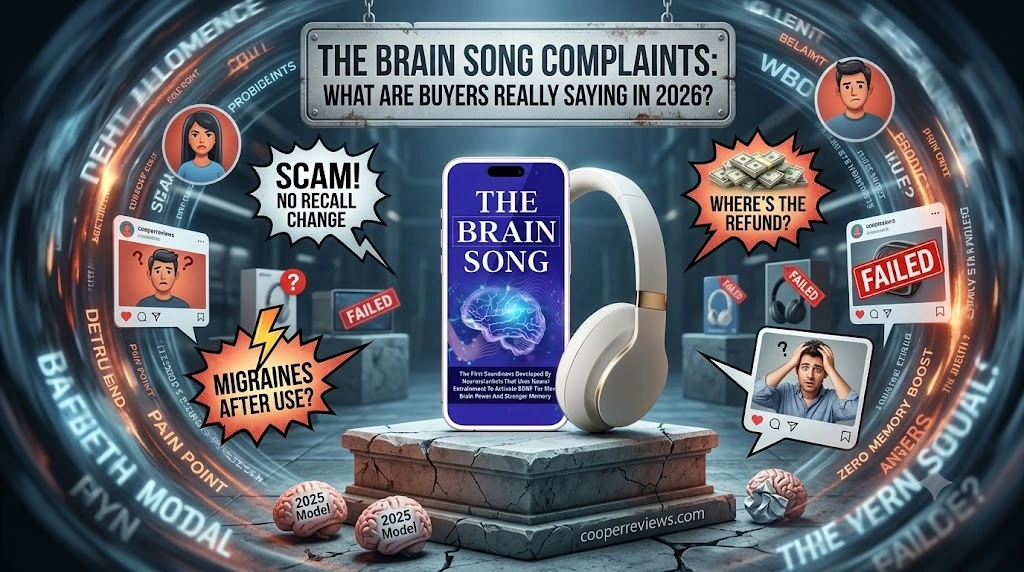
The Brain Song Complaints: What Are Buyers Really Saying In 2026?
The Brain Song Complaints: The Short Answer
If you’re searching for The Brain Song complaints, you’re probably not looking for another glowing sales pitch. You want to know what could go wrong, what users may dislike, whether the audio experience lives up to expectations, and whether the program deserves your money.
That’s exactly how I think buyers should approach any wellness product.
The Brain Song is an audio-based wellness program marketed around focus, memory, mental clarity, and sound-based stimulation. But the important distinction is this: research into auditory stimulation and brainwave entrainment does not automatically prove that one commercial audio program will produce a particular result for every listener.
That distinction matters.
Research on binaural beats and related auditory stimulation has produced interesting findings, including evidence of potential effects on attention and memory, but researchers also describe limitations and mixed results. A systematic review and meta-analysis published in Psychological Research found an overall positive effect for binaural-beat interventions while noting conflicting findings across individual studies and the need for better-designed research.
So, are the complaints worth taking seriously?
Yes—but complaints should be separated into genuine product concerns, expectation problems, individual differences, and claims that simply aren’t supported by strong evidence.
That’s what I’ll unpack below.
What Are People Actually Complaining About?
The most useful way to evaluate The Brain Song complaints is to look at the practical concerns a cautious buyer would have before spending money.
Rather than pretending every online comment represents a verified customer, I prefer to look at complaints as questions that need investigation.
Some online discussions about The Brain Song raise concerns around expectations, how quickly results may appear, the audio experience, scientific claims, and whether the program is suitable for everyone. However, online posts should not automatically be treated as verified customer reviews.
For example, some web discussions describe disappointment from people who expected noticeable cognitive changes very quickly. Other discussions question whether marketing language goes further than the underlying research can support.
Those are reasonable questions.
But there’s another side to this.
A person listening to an audio program for five minutes and experiencing no obvious change doesn’t necessarily prove that the program is ineffective. Likewise, someone reporting that they felt more focused doesn’t prove that the product has a clinically established effect.
Both experiences can exist without either one being definitive scientific evidence.
That is one of the biggest lessons I’ve learned from researching wellness products.
Complaint #1: “I Didn’t Notice Anything”
The most important complaint to understand is simply that an individual may use an audio program and notice little or nothing.
This is a legitimate consumer possibility.
Auditory stimulation is not comparable to taking a medication where a specific pharmacological dose can be measured. Your experience can be influenced by your expectations, environment, headphones, attention, sleep, stress, and what you’re doing while listening.
Research into binaural beats illustrates this uncertainty. A meta-analysis found potentially meaningful effects on memory and attention, but the researchers also described mixed findings between studies.
That means I would be skeptical of anyone telling you:
“Listen once and you’ll definitely feel a dramatic difference.”
That’s not a reasonable expectation.
A more sensible approach is to treat an audio program as an experiment in your personal routine.
For example:
- Listen under similar conditions each day.
- Avoid changing five other habits simultaneously.
- Track how you feel before and after.
- Give yourself enough time to identify a pattern.
- Stop if the experience is unpleasant.
This turns a vague question—“Does it work?”—into a more useful one:
“Does this particular routine seem useful to me?”
Complaint #2: “I Expected Results Too Quickly”
A second concern is the gap between marketing expectations and real-world expectations.
This is particularly important for people searching for Brain Song reviews 2026 because online wellness marketing often compresses complicated science into simple promises.
Memory and attention aren’t controlled by a single switch.
The National Institute on Aging explains that cognitive health is influenced by many factors, including genetics, environmental factors, physical health, mental health, sleep-related issues, and lifestyle.
So if someone has been sleeping poorly, experiencing significant stress, eating irregularly, or dealing with another health problem, an audio routine shouldn’t automatically be expected to overcome everything else.
I actually think this is where responsible buyers have an advantage.
Instead of asking:
“How quickly will this fix my brain fog?”
Ask:
“Can this become one small, consistent part of a broader routine that supports my focus?”
That’s a much more realistic question.
Complaint #3: “The Audio Isn’t What I Expected”
Audio wellness products can be surprisingly subjective because people have very different preferences for tones, frequencies, repetition, and listening environments.
Some people enjoy repetitive sound patterns.
Others find them distracting.
Some prefer music.
Others want silence.
And some people simply don’t enjoy listening to headphones for an extended period.
This matters because the theoretical mechanism behind auditory entrainment isn’t the same thing as enjoying the actual listening experience.
A 2024 systematic review examined music, ambient noise, white noise, and binaural beats in relation to cognition and attention. The researchers concluded that the evidence was mixed or insufficient for firm conclusions about several proposed effects.
So if you find the sound distracting, uncomfortable, or irritating, that’s useful information.
You don’t have to force yourself to use a wellness tool simply because someone online says you should.
Complaint #4: “The Science Sounds More Certain Than It Really Is”
This is probably the complaint I would take most seriously when evaluating any brain-health product.
There’s a huge difference between:
“Scientists are researching this mechanism.”
and:
“This product is scientifically proven to produce this specific result.”
Those statements are not interchangeable.
There is legitimate research into auditory stimulation, brain rhythms, attention, memory, and neural synchronization.
For example, research involving binaural beats has found potentially positive effects in some cognitive tasks. But the scientific literature also contains conflicting results and methodological limitations.
The responsible conclusion is therefore not “sound frequencies don’t work.”
Nor is it:
“Sound frequencies definitely improve everyone’s memory.”
The responsible conclusion is:
There is interesting research worth exploring, but evidence for a specific commercial program should be evaluated separately from evidence for the broader concept.
That’s an important distinction for consumers.
Complaint #5: “Can I Trust the Testimonials?”
Testimonials can be useful for understanding personal experiences, but they shouldn’t be confused with clinical evidence or guaranteed outcomes.
Suppose one person says:
“I felt more focused after listening.”
That’s their experience.
It doesn’t establish that another person will experience the same thing.
The FTC specifically warns that health-related advertising claims need appropriate substantiation and that testimonials cannot be used to imply unsupported health outcomes.
That’s why I would be cautious with dramatic before-and-after stories.
A testimonial can make you curious.
It shouldn’t make your decision for you.
When reading Brain Song reviews and complaints, ask:
- Is the reviewer clearly a genuine user?
- Is the date of the experience known?
- Are specific claims being made?
- Is the reviewer affiliated with the seller?
- Does the story describe typical experience or an unusual result?
- Is there independent evidence supporting the claim?
Those questions can eliminate a surprising amount of online noise.
The Brain Song Complaints vs. Legitimate Buyer Questions
Not every negative comment is evidence of a product defect; sometimes a “complaint” is actually a question about expectations.
Here’s how I would categorize them:
| Buyer concern | What it may actually mean |
|---|---|
| “Nothing happened immediately” | Expectations may have been too high |
| “I don’t like the audio” | Personal listening preference |
| “I need headphones” | Practical usage consideration |
| “I haven’t noticed a change” | Individual response varies |
| “The science sounds complicated” | Marketing may need clearer explanation |
| “I want clinical proof” | A reasonable request for stronger evidence |
| “It isn’t for me” | A completely legitimate consumer conclusion |
This is why simply counting negative comments isn’t enough.
You need context.
Is The Brain Song Legit or a Scam?
A “scam” conclusion should not be based simply on whether someone liked or disliked the audio.
The better question is whether the product, seller, advertising, payment process, refund policy, and claims can be evaluated transparently.
I would investigate several things before purchasing:
1. What exactly are you buying?
Is it a digital audio program, physical product, subscription, or combination?
2. What does it cost?
Make sure you understand whether the advertised price is a one-time payment or recurring charge.
3. What is the refund policy?
Read the actual terms rather than relying solely on promotional language.
4. What claims are being made?
Be particularly cautious with claims suggesting that a wellness product can diagnose, prevent, treat, or cure a medical condition.
5. Is the evidence product-specific?
Research about a general technology doesn’t automatically validate a particular commercial product.
That’s a standard I believe every consumer should use.
What Does Science Say About Audio, Memory and Focus?
Research suggests that certain forms of auditory stimulation may influence attention and memory, but the evidence isn’t strong enough to treat every commercial audio program as a guaranteed cognitive intervention.
A 2019 meta-analysis of binaural auditory beats reported a medium overall effect across cognition, anxiety, and pain-related outcomes, while also finding that factors such as timing and exposure duration influenced outcomes.
A later systematic review and meta-analysis focused specifically on memory and attention reported an overall medium effect but emphasized conflicting findings and the need for more robust research.
That’s encouraging—but it isn’t the same as saying:
“The Brain Song definitely improves memory.”
The product-specific question remains separate.
And that’s exactly where many online reviews become misleading.
What About Brain Health After 40 or 50?
Changes in memory and concentration can have many explanations, so an audio program shouldn’t be used as a substitute for investigating persistent cognitive symptoms.
The National Institute on Aging notes that occasional forgetfulness can occur with normal aging, while significant or worsening memory problems can sometimes signal other issues that deserve medical evaluation.
This is particularly important if you’re experiencing:
- Rapidly worsening memory
- Difficulty completing familiar everyday tasks
- Confusion
- Major changes in personality or behavior
- Problems that interfere with driving or work
- Sudden cognitive changes
An audio wellness routine may be something you explore alongside healthy habits, but it shouldn’t delay professional evaluation when symptoms are persistent or concerning.
A Better Way to Test Brain Song for Yourself
If you’re curious about The Brain Song, a simple personal tracking experiment can be more informative than relying entirely on online testimonials.
I’d keep it uncomplicated.
Before starting
Rate these areas from 1–10:
- Mental clarity
- Focus
- Energy
- Ability to stay on task
- Recall
- Overall mental fatigue
Then listen consistently under similar circumstances.
For example, you might use it during your morning routine rather than randomly at different times every day.
After several weeks
Repeat the same ratings.
Don’t ask yourself:
“Do I feel magically different?”
Ask:
“Have I noticed any consistent pattern?”
That distinction reduces confirmation bias.
And if you see no meaningful change?
That’s a valid result too.
A product doesn’t have to work for you simply because it works for someone else.
The Brain Song Complaints: What I Would Watch Before Buying
My biggest takeaway is that the strongest buyer protection comes from realistic expectations rather than dramatic promises.
Before purchasing, I’d check these six things:
1. Product description
Understand exactly what the program contains.
2. Price
Know the total cost before entering payment information.
3. Refund terms
Save a copy of the refund policy at the time of purchase.
4. Scientific claims
Separate research about auditory stimulation from evidence specifically testing the product.
5. User experiences
Look for balanced reviews rather than only glowing testimonials.
6. Your own circumstances
Consider whether your expectations are realistic and whether persistent cognitive symptoms should be discussed with a healthcare professional.
This approach takes a few minutes but can prevent an impulsive purchase.
My Take After Looking at the Complaints
The Brain Song complaints don’t automatically convince me that the product is ineffective, but they do reinforce why buyers should approach it with realistic expectations.
The biggest issue isn’t necessarily whether somebody online liked it.
It’s whether you’re expecting too much from it.
If you’re looking for a simple audio routine that you can test consistently as part of your focus or wellness habits, it may be worth researching.
If you’re expecting seven minutes of audio to guarantee dramatic memory changes, I would slow down.
The science surrounding auditory stimulation is interesting, but it remains an evolving area.
And that’s why I wouldn’t base my decision on one testimonial—or one complaint.
What I Would Check Before Spending Money
Here’s my personal buyer checklist:
- Read the product information carefully.
- Check the current price and payment terms.
- Read the refund policy before purchasing.
- Look for evidence supporting specific claims.
- Don’t confuse general research with product-specific evidence.
- Decide what result you’re realistically hoping to measure.
- Track your own experience rather than relying entirely on testimonials.
- Stop using it if the experience causes discomfort or other problems.
- Talk with a qualified healthcare professional about persistent cognitive symptoms.
- Only buy if the product fits your expectations and budget.
That’s a much more useful framework than simply asking whether something is “good” or “bad.”
Read My Full Brain Song Review Before You Decide
If you’re still curious after reading the complaints, I’ve gone deeper into the product itself rather than focusing only on the headline claims.
My full review looks at the program, how the audio approach is presented, what I experienced, the potential benefits and limitations, and the questions I’d want answered before recommending it to someone else.
If you’re considering buying, I’d read the full breakdown first rather than making the decision from a single review or advertisement.
Read my in-depth Brain Song review for 2026
There you’ll find a more detailed look at the product and my overall assessment.
Frequently Asked Questions About The Brain Song Complaints
Are there negative reviews of The Brain Song?
Yes, negative discussions and complaints can be found online, particularly around expectations, perceived lack of results, the listening experience, and questions about marketing claims. However, online comments aren’t automatically verified customer reviews, so they should be treated as individual experiences rather than definitive evidence.
What is the most common Brain Song complaint?
One recurring concern in online discussions is that some people don’t notice a meaningful difference quickly. That’s a legitimate experience, but it doesn’t establish that the product cannot help anyone. Individual responses to auditory wellness tools can vary considerably.
Does The Brain Song have side effects?
There isn’t enough independent evidence to characterize a specific side-effect profile for the commercial program. Some people may simply dislike or find certain sounds uncomfortable or distracting. Anyone experiencing unusual or persistent symptoms should stop and seek appropriate professional advice.
Does Brain Song really work?
The broader research into auditory stimulation and binaural beats is promising but mixed. Some studies and meta-analyses report potential benefits for attention or memory, while researchers also highlight limitations and inconsistent findings. Evidence for a general mechanism should not automatically be interpreted as proof that every commercial program produces the same outcomes.
Is The Brain Song scientifically proven?
I would avoid describing it as universally “scientifically proven.” Research exists on auditory stimulation, brain rhythms, and related techniques, but consumers should distinguish between peer-reviewed research on a general concept and controlled studies specifically testing the commercial Brain Song product.
Should I buy The Brain Song?
That depends on your expectations. If you’re interested in trying an audio-based wellness routine and understand that results can vary, you can investigate it further. If you’re looking for a guaranteed solution for a medical or cognitive condition, this isn’t an appropriate expectation for a commercial audio program.
Final Verdict: Are The Brain Song Complaints a Red Flag?
Not necessarily—but they are a reminder to investigate before buying.
The most reasonable conclusion I can draw from the available information is that The Brain Song should be evaluated as an audio-based wellness product rather than as a guaranteed solution for memory or cognitive problems.
The research surrounding auditory stimulation is interesting. Some studies suggest potential benefits for attention and memory, while systematic reviews also point to mixed findings and the need for stronger research.
The National Institute on Aging also makes an important broader point: cognitive health is influenced by multiple factors, including physical health, mental health, lifestyle, and age-related changes.
So if you’re researching The Brain Song complaints, don’t just ask, “Did someone online love it?”
Ask better questions:
What exactly am I buying?
What evidence supports the claims?
What happens if it doesn’t work for me?
Are my expectations realistic?
Have I compared personal testimonials with independent research?
Those questions will give you a much clearer picture.
And if you’re considering Brain Song yourself, I recommend reading my complete product review before making a decision:
Read my real-world Brain Song review and full analysis
Ultimately, the smartest buyer isn’t the person who believes every positive review—or every complaint. It’s the person who investigates both sides and makes an informed decision.
Sources & Further Reading
For readers who want to investigate the science and consumer-protection side themselves:
- National Institute on Aging — Cognitive Health and Older Adults — Background on the many factors affecting cognitive health and memory.
- National Institute on Aging — Memory Loss and Forgetfulness — Guidance on normal forgetfulness versus potentially concerning memory changes.
- PubMed — Binaural Beats, Memory and Attention Meta-Analysis — Systematic review and meta-analysis of auditory beat interventions.
- PubMed — Efficacy of Binaural Auditory Beats in Cognition — Meta-analysis examining cognitive and other outcomes.
- PubMed — Music and Auditory Stimulation Systematic Review — Review of auditory stimulation and cognitive/attention outcomes.
- FTC — Health Products Compliance Guidance — Guidance concerning evidence, testimonials, and health-related marketing claims.
Note: These are independent educational and regulatory resources, not endorsements of Brain Song.