
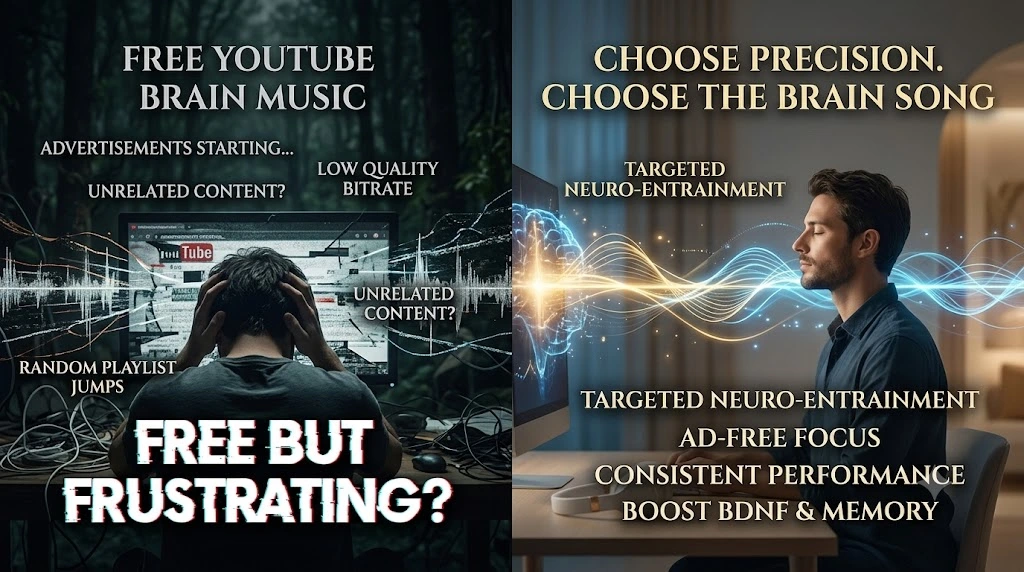
Why Choose Brain Song Over Free YouTube Brain Music?
If you have ever searched YouTube for brain music, binaural beats, gamma waves, or focus sounds, you already know how much free audio is available. Some recordings run for ten minutes, while others continue for hours. So why would anyone pay for a programme such as The Brain Song when similar-sounding audio can be found online for nothing?
The honest answer: you may not need to pay for brain music at all. Free YouTube audio can be a perfectly reasonable starting point. A paid programme becomes worth considering when you prefer a specific, ready-to-use listening routine and have checked that its features, price, and terms suit your needs.
In this comparison, we examine what separates The Brain Song from free YouTube brain music, how binaural beats work, what the science actually supports, and which option makes the most sense for American buyers.
Want the full Brain Song breakdown?
Review the product’s advertised benefits, buying considerations, pricing information, and important limitations before deciding whether it fits your needs.
Read the Brain Song Honest Review →The Brain Song vs Free YouTube Brain Music: Quick Comparison
| Feature | The Brain Song | Free YouTube Brain Music |
|---|---|---|
| Upfront cost | A paid digital programme; one version reviewed advertises $39, but verify the current checkout price. | Usually free to watch, subject to internet access and platform conditions. |
| Listening format | A dedicated audio programme; confirm the exact version and deliverables before buying. | Individual videos, playlists, livestreams, and long-form recordings. |
| Selection | A specific programme rather than searching through many videos. | A huge variety of creators, sounds, durations, and claimed frequencies. |
| Listening routine | Potentially simpler if you prefer one designated recording. | You choose your own track, length, and schedule. |
| Headphones | Standard stereo headphones or earbuds are generally suitable for binaural audio. | Stereo headphones are generally needed to perceive binaural beats properly. |
| Evidence | Product claims should not be treated as proof of effectiveness. | A video’s title or description is not scientific evidence either. |
| Refunds | Check the current seller’s written terms before ordering. | No purchase means no product refund to request. |
| Best fit | People who value a packaged, convenient routine and accept the cost. | People who want to experiment, compare recordings, or spend nothing. |
Important: Product names and sales pages can describe different versions of The Brain Song. Pricing, audio duration, bonuses, and refund terms may change. Verify the exact offer presented at checkout before making a purchase.
1. What Is The Brain Song?
The Brain Song is marketed as a digital audio programme that uses sound-based techniques associated with binaural beats and brainwave stimulation. Its sales material connects the listening experience with goals such as focus, memory, mental clarity, or a more productive daily routine.
That description needs context. An audio programme is not a medical treatment, and marketing language about brainwaves does not prove that a recording will improve your memory, attention, or mental performance.
Binaural beats are an auditory phenomenon. When a person hears slightly different tones in the left and right ears, the brain can perceive a beat corresponding to the difference between those tones. Researchers have investigated whether this kind of stimulation can influence brain activity and psychological states.
The key question for a buyer is not simply whether binaural beats exist. They do. It is whether a particular commercial recording produces the advertised outcomes reliably, and whether those outcomes justify paying for it.
Before ordering, check what the current Brain Song offer actually includes. Confirm the audio format, access instructions, advertised listening time, any supplementary materials, the total price, and the applicable refund policy. Do not assume every page using a similar product name describes an identical version.
For more detail, see our analysis of whether The Brain Song actually works.
2. Why Is Free YouTube Brain Music So Popular?
Free brain music has an obvious advantage: there is little financial risk in trying it.
Search YouTube for “binaural beats for focus,” “brain music for studying,” or “relaxing background sounds,” and you will find recordings in a wide range of styles. Some use gentle ambient music. Others feature nature sounds, steady tones, rhythmic pulses, or audio labelled with specific frequencies.
That variety makes YouTube useful for discovering what you enjoy.
You can test different sounds
Not everyone finds the same audio comfortable. One person may prefer soft ambient music, while another finds repetitive tones distracting. With free recordings, you can sample different approaches without committing to a paid product.
You can choose your own listening time
Need ten minutes of quiet before starting work? You can find a short recording. Want background ambience while studying? Longer videos may be more convenient.
You can start without buying anything
If your main goal is to create a calmer work environment, ordinary instrumental music or quiet background sound may already serve that purpose. There is no scientific rule that says you must purchase a specialised audio programme to concentrate.
The drawback is finding the right recording
YouTube offers choice, but too much choice can become a distraction. You may spend more time comparing thumbnails, reading comments, and switching videos than actually completing your task.
Some videos also make dramatic claims about memory, intelligence, sleep, or brainwave frequencies. A compelling title does not establish that those claims are true.
Free content is therefore a practical starting point, but it still requires sensible selection and realistic expectations.
3. Why Choose Brain Song Over Free YouTube Brain Music?
There are several reasons a buyer might prefer a paid audio programme. The strongest reasons are about convenience and consistency—not a promise that it will make the brain work better.
Reason 1: A more defined listening routine
With YouTube, you decide which recording to use, how long to listen, and when to switch tracks. That flexibility is helpful for some people but frustrating for others.
A dedicated programme may appeal if you would rather follow one defined listening routine than search for a new recording every day.
For example, imagine that you begin work at the same time each morning. You might prefer to use one familiar audio track before opening your email and starting your first task. The value is in having a repeatable routine that requires little planning.
However, a paid recording is not automatically more effective than a free one. If you already have a YouTube track you enjoy and use consistently, there may be little practical reason to replace it.
Reason 2: Less time spent searching
The internet contains an enormous amount of brain music. Finding an appropriate recording can involve testing several options, checking their duration, adjusting volume, and deciding which sound you can tolerate.
A packaged programme can reduce that selection process. For people who value simplicity, having a dedicated audio product may be worth something.
But convenience has a personal value, not a universal price. If finding free audio takes you only a minute, the advantage may be negligible. If endless searching repeatedly interrupts your work, a more structured option may be attractive.
Reason 3: A more consistent experience
Switching between different creators and recordings can mean changing the sound, duration, volume, and audio design each time. A single programme may offer a more consistent experience, depending on the version purchased.
Consistency can make it easier to assess whether you enjoy the routine. You can use the same recording under similar conditions rather than changing several variables at once.
Still, consistency should not be confused with proven cognitive improvement. A familiar sound may feel comfortable or help establish a work ritual, but that does not demonstrate a measurable increase in intelligence, memory, or productivity.
Reason 4: A dedicated product rather than a collection of videos
Some buyers simply prefer a product that has been packaged for a specific purpose. They may be comfortable paying for convenience, provided they understand what they are receiving.
That preference is legitimate. People pay for organised courses, guided meditation programmes, and curated playlists even when free alternatives exist.
The important distinction is between paying for organisation and paying because you believe the product has guaranteed neurological benefits. The first is a personal purchasing decision. The second requires evidence that marketing alone cannot provide.
Reason 5: A possible fit for a daily habit
If you like listening to audio before studying, planning, or beginning a demanding work session, a dedicated track may become part of that routine.
But the habit itself can be built with free music. You do not need a paid programme to set aside ten minutes, silence notifications, take a few comfortable breaths, and prepare for a focused work session.
The practical advantage of The Brain Song is its potential convenience—not proof that it outperforms every free YouTube recording.
Check the product details before spending money
Read our main review to evaluate the advertised features, claims, price considerations, and questions to verify before ordering.
Read the In-Depth Brain Song Review →4. What Does Science Say About Binaural Beats and Focus?
This is the most important part of the comparison for buyers who want evidence rather than advertising.
Binaural beats have been studied in relation to brain activity, attention, memory, mood, and relaxation. The research is interesting, but it does not support treating every binaural-beat recording as a reliable cognitive-enhancement tool.
A 2023 systematic review published in PLOS ONE examined 14 studies investigating binaural beats and brainwave entrainment. Five studies reported results consistent with the entrainment hypothesis, eight reported contradictory findings, and one reported mixed results. The researchers also identified substantial differences in study methods, making results difficult to compare.
Read the research: 2023 systematic review of binaural beats in PLOS ONE.
A 2025 study published in PLOS ONE investigated short, self-administered binaural-beat sessions. It reported improvements in participants’ ratings of calmness and focus under certain conditions. That is a potentially useful finding, but subjective ratings following brief sessions do not establish that every commercial audio product improves real-world work performance or memory.
Read the study: 2025 study on self-administered binaural beats.
What does this mean for an ordinary American buyer?
- Binaural beats are a real auditory phenomenon.
- Researchers are investigating possible effects on brain activity and subjective states.
- Findings vary across studies and outcomes.
- Evidence about a technique in general does not automatically validate a particular product.
- No responsible reviewer should guarantee better memory, sharper intelligence, or increased productivity from listening to The Brain Song.
You can still enjoy an audio programme as part of a personal routine. The sensible approach is to evaluate how it fits your needs without assuming that a specific frequency will produce a specific result.
5. Is The Brain Song Better Than Free YouTube Audio?
There is no universal winner. The answer depends on what you want and whether the paid programme provides value beyond what you already use.
| Your priority | Practical starting point |
|---|---|
| Spending no money | Free YouTube audio |
| Exploring different sounds | Free YouTube audio |
| Having a dedicated, repeatable programme | The Brain Song may suit you |
| Avoiding time spent searching | A paid programme may be more convenient |
| Proven improvement in memory or intelligence | Neither option should be assumed to provide it |
| Trying audio before making a purchase | Free recordings |
| Having a written refund policy | Review the paid offer’s exact terms before buying |
Consider a simple example. A college student in Texas already listens to a free instrumental track while studying and finds it comfortable. Purchasing another audio product may not add enough value to justify the expense.
Now consider a remote professional who regularly wastes time searching for different recordings and prefers one dedicated routine. That person may be more interested in a paid programme, provided the price is acceptable and the offer delivers what it promises.
The difference is not that one listener deserves better brain music. It is that different people value convenience differently.
6. How Much Does The Brain Song Cost?
Price is an important part of the decision, particularly when free alternatives are readily available.
One version of The Brain Song has been advertised at $39 as a one-time payment. Treat that figure as a reference point, not a guaranteed current price. Product pages and offers can change, and similar product names may refer to different sales pages.
Before paying, check:
- The total amount charged: Confirm the price displayed at checkout, including any applicable additional charges.
- Payment frequency: Verify whether the offer is a one-time purchase or involves recurring payments.
- What is included: Check whether you receive the advertised audio, supplementary materials, and any stated bonuses.
- Access and compatibility: Review how the files are delivered and which devices can play them.
- Refund eligibility: Read the exact policy, time limit, and instructions for requesting a refund.
If the current offer still costs around $39, ask yourself a straightforward question: would the convenience of a dedicated programme be worth that amount to you, given that you can already access free audio?
If you are unsure, there is no need to rush. Try free recordings first, identify what you like, and pay only if the dedicated programme offers something you genuinely value.
For additional buying considerations, read our Brain Song price guide.
7. Do You Need Special Headphones?
Usually, no high-end headphones are necessary for ordinary binaural-beat listening.
Binaural beats rely on presenting different tones separately to the left and right ears. Standard stereo headphones or stereo earbuds are generally sufficient to deliver that separation. You do not automatically need expensive studio headphones or specialised equipment.
A few practical tips:
- Use headphones or earbuds that provide separate left and right audio channels.
- Keep the volume comfortable rather than turning it up to force concentration.
- Choose a quiet environment if external noise distracts you.
- Check the programme’s own instructions, because different recordings may use different audio methods.
A mono recording, where the same sound is sent to both ears, will not create the same binaural perception as properly separated stereo tones. Some audio programmes may include other sound layers, so check the specific product description rather than assuming every version works identically.
You can use a phone, tablet, or computer that supports the required audio format. The key requirement is suitable playback, not expensive equipment.
8. What Are the Advantages and Disadvantages of The Brain Song?
An honest review should consider both sides before recommending a purchase.
Potential advantages
- A dedicated routine: A single programme may be easier to incorporate into a daily schedule than repeatedly searching for different recordings.
- Less decision-making: If you know what you want to listen to, a packaged option may reduce the effort spent choosing audio.
- Digital convenience: A digital audio product can be convenient if the current offer provides compatible files and clear access instructions.
- A defined purchase offer: A sales page may provide a stated price and refund policy, giving buyers specific terms to review before ordering.
Potential disadvantages
- It costs money: Free alternatives are widely available, so the programme must justify its cost through convenience or features that matter to you.
- Benefits are not guaranteed: Scientific research on binaural beats is mixed, and general research cannot establish the effectiveness of this particular product.
- Product details can change: Buyers should verify the exact audio version, included materials, price, and refund terms rather than relying on outdated descriptions.
- It may not suit everyone: Some people find repetitive tones distracting or unpleasant. Others prefer silence, conventional music, or environmental sounds.
- It is not a substitute for professional help: Persistent concentration problems, severe fatigue, or memory changes may have causes that audio cannot address.
Who might consider it?
The Brain Song may be worth investigating if you enjoy audio-based routines, value convenience, understand the evidence limitations, and are comfortable paying for a dedicated programme.
Who should stick with free audio?
Free YouTube recordings are a sensible choice if you are experimenting with binaural beats, have already found a track you enjoy, or do not want to spend money on an unproven cognitive benefit.
9. Is The Brain Song a Scam or Legitimate Product?
A fair assessment requires more than a dramatic headline or a collection of positive comments.
First, distinguish between whether a product is actually sold and whether its advertised benefits have been independently established. A digital audio programme may be available for purchase without there being strong clinical evidence that it delivers every result suggested by its marketing.
Before buying, review the seller identity, payment processor, product description, contact information, refund terms, and checkout total. Make sure the page you visit matches the product discussed in the review. Do not assume a page is official simply because it uses the product name or similar branding.
Be cautious of claims that a recording will guarantee better memory, reverse cognitive decline, treat a medical condition, or produce dramatic results in a fixed number of days. Strong claims require strong evidence.
A refund policy can reduce financial risk if its terms are genuine and applicable to your order, but it is not proof of effectiveness. Similarly, testimonials can describe individual experiences, but they do not establish what most buyers will experience.
For a more detailed discussion of the offer and its claims, read our Brain Song scam-or-legit analysis.
10. Frequently Asked Questions
Is The Brain Song better than free YouTube brain music?
Not necessarily. The Brain Song may appeal to people who prefer a dedicated programme and a simpler listening routine. Free YouTube audio offers variety without an upfront purchase. There is no sound basis for claiming that the paid product automatically produces better cognitive results.
Can free YouTube binaural beats improve focus?
Some people may find particular audio helpful for creating a comfortable work environment or settling into a routine. Research into binaural beats and attention remains mixed, so individual experiences should not be interpreted as proof of a reliable effect.
Is The Brain Song worth $39?
It depends on the current offer and your priorities. If the programme is still advertised at $39, consider whether its convenience and included features justify the cost compared with free recordings. Confirm the price and terms at checkout before purchasing.
Do I need expensive headphones for The Brain Song?
Generally, standard stereo headphones or earbuds are sufficient for binaural audio. High-end equipment is not automatically required. Follow the instructions for the specific version you purchase.
Can I listen to brain music while working or studying?
You can experiment with background audio if it does not distract you. Some tasks require close attention to speech or complex information, so silence may work better. Compare your experience with and without audio instead of assuming that a particular sound always improves performance.
Does The Brain Song guarantee better memory or intelligence?
You should not expect a guarantee of improved memory, intelligence, or productivity. Binaural-beat research is still developing, and findings about the technique do not establish guaranteed outcomes from a specific commercial recording.
Is a paid brain music programme necessary?
No. You can create a listening routine using free audio, ordinary music, or silence. A paid programme is an optional purchase, not a requirement for concentration or personal development.
11. Final Verdict: Should You Choose The Brain Song Over Free YouTube Brain Music?
The choice comes down to convenience, cost, and realistic expectations.
Free YouTube brain music is hard to beat if your main goal is to experiment with different sounds without spending money. You can compare recordings, find a comfortable listening style, and build a routine using resources that are already available.
The Brain Song may be worth considering if you prefer a dedicated audio programme, value having a consistent option ready to use, and are comfortable paying for that convenience. Before ordering, verify the exact product version, price, included materials, access method, and refund conditions.
What you should not pay for is a promise of guaranteed intelligence, perfect concentration, or dramatic memory improvement. The scientific evidence on binaural beats does not justify those guarantees.
My recommendation is straightforward: start with the option that meets your needs at the lowest reasonable cost. If free audio already works for your routine, you may have no reason to switch. If you want to evaluate a packaged programme, investigate the actual offer and make your decision based on its features—not exaggerated claims.
Want to examine The Brain Song before you decide?
Our in-depth review takes a closer look at the product, advertised benefits, pricing considerations, and important questions to ask before purchasing.
Read the Brain Song Honest & In-Depth Review →Review the details, check the current terms, and decide whether the programme offers enough practical value for your situation.