
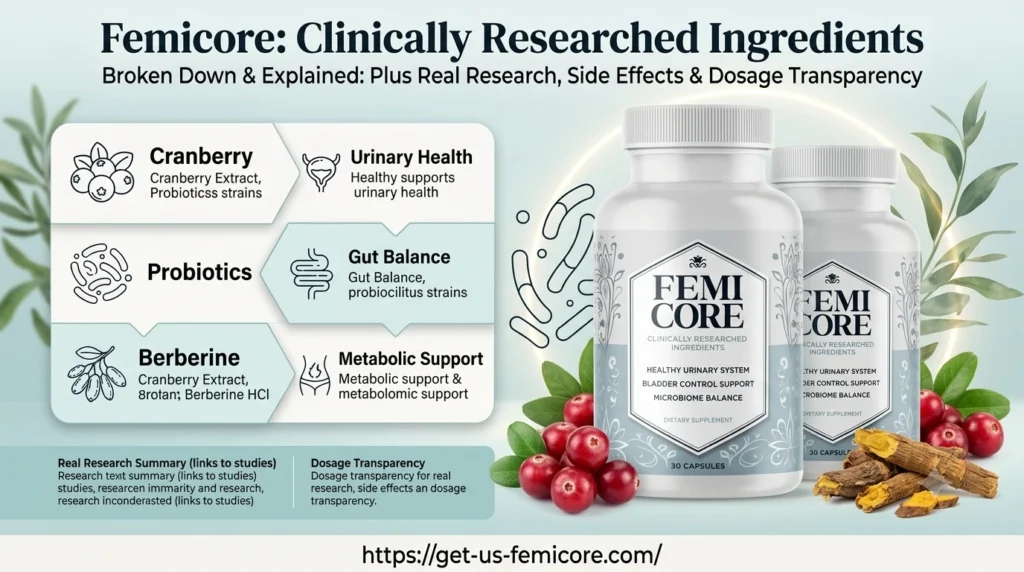
A straightforward, ingredient-by-ingredient look at FemiCore Ingredients Explained— the botanicals, the probiotic strains, and the real research (and its limits) behind each one.
Most product pages list ingredients in a single paragraph and move straight to the buy button. That’s not very useful if you’re actually trying to figure out what you’d be putting in your body every day. So this article does the opposite: it goes through every FemiCore Ingredients Explained formula on its own, with what the actual research says about it — including the parts where the evidence is still thin, which most marketing copy conveniently skips.
What’s Actually in FemiCore Ingredients?
FemiCore’s formula is built around nine ingredients, split into two groups: four botanical extracts and a five-strain probiotic blend.
| Ingredient | Category | What It’s Included For |
|---|---|---|
| Cranberry Extract | Botanical | Blocking bacterial adhesion to the bladder wall |
| Berberine HCl | Botanical | Traditional antibacterial / metabolic support |
| Bearberry (Uva Ursi) | Botanical | Traditional urinary-tract support |
| Mimosa Pudica | Botanical | Traditional antimicrobial / gut-urinary support |
| Lactobacillus crispatus | Probiotic | Urogenital microbiome support |
| Lactobacillus acidophilus | Probiotic | Urogenital microbiome support |
| Lactobacillus plantarum | Probiotic | Urogenital microbiome support |
| Lactobacillus gasseri | Probiotic | Urogenital microbiome support |
| Lactobacillus casei | Probiotic | Urogenital microbiome support |
Let’s go through each category in more depth.
→ See the full ingredient list and current pricing on FemiCore’s official page
Cranberry Extract
Cranberry is the ingredient most people already associate with urinary health, and it’s also the one whose evidence base has changed the most recently. For years, mainstream sources — including Mayo Clinic — were openly skeptical that cranberry supplements did much of anything. That changed with an updated 2023 Cochrane review, one of the most rigorous forms of medical evidence available, which pooled 50 randomized trials across nearly 9,000 participants and found moderate-certainty evidence that cranberry products reduce the risk of symptomatic UTIs.
The mechanism, according to the NIH Office of Dietary Supplements, comes down to proanthocyanidins (PACs) — compounds that appear to stop E. coli from attaching to the bladder wall in the first place, which is the first step in most urinary tract infections. The benefit is clearest in women with recurrent UTIs, children, and people recovering from certain bladder procedures — the same review notes the evidence doesn’t clearly support cranberry for elderly people, pregnant women, or people with bladder-emptying problems, so it’s not a universal fix, but it’s considerably more credible than it was a few years ago.
The Probiotic Blend in FemiCore Ingredients: Five Lactobacillus Strains
FemiCore includes five specific Lactobacillus strains — crispatus, acidophilus, plantarum, gasseri, and casei — rather than a single generic “probiotic” listing. This matters because research in this space is increasingly strain-specific rather than treating “probiotics” as one interchangeable category.
The clearest human evidence comes from a randomized, placebo-controlled trial out of Tabriz, Iran, published in Probiotics and Antimicrobial Proteins, which gave postpartum women a daily Lactobacillus acidophilus capsule for eight weeks and found a reduced incidence of UTIs compared with placebo. The underlying idea is that a healthy urogenital microbiome — not just a gut microbiome — plays a real role in resisting the bacteria that cause most UTIs, by competing for space and maintaining a more acidic, less hospitable environment for pathogens like E. coli.
It’s worth being fair about the limits here too: this is one trial in one population (postpartum women), not a large-scale, generalizable dataset covering everyone who might take this formula. But it fits a broader and growing body of research on specific Lactobacillus strains and urinary tract health, which is why multi-strain probiotic blends have become increasingly common in newer bladder-support formulas rather than older, single-ingredient approaches.
Berberine HCl
Berberine has a long history of traditional use and a much larger evidence base for blood sugar and metabolic health than for urinary health specifically. Laboratory (in vitro) research suggests it can interfere with E. coli‘s ability to stick to bladder cells and form protective biofilms — both of which are steps bacteria rely on to establish an infection.
What’s missing so far is a large, dedicated human clinical trial testing berberine on its own specifically for urinary tract health. Most of the direct human data available comes from narrower studies, including research in people with type 2 diabetes and recurrent UTIs, rather than the general population. It’s also genuinely worth knowing that berberine can interact with certain medications, so if you take other prescriptions — particularly for blood sugar or blood pressure — it’s worth mentioning to your doctor or pharmacist before adding it to your routine.
Bearberry (Uva Ursi)
Bearberry leaf has centuries of traditional use for urinary complaints, largely due to a compound called arbutin. Some pharmacological safety reviews argue that at standard recommended doses, human risk is low. That said, mainstream consumer health references — including WebMD — are more cautious: the general guidance is to avoid continuous, indefinite daily use, and to skip it entirely during pregnancy or breastfeeding, or if you have significant liver or kidney disease.
This is the one caveat worth sitting with a little longer, because FemiCore (like most formulas in this category) is designed for daily, ongoing use — which is somewhat in tension with the traditional “short course, not indefinite” guidance around bearberry specifically. It’s not a reason to avoid the product outright, but it is a legitimate reason to have a quick conversation with your doctor about appropriate duration of use, especially if you’re planning to take it for months at a time rather than a few weeks.
Mimosa Pudica
Mimosa pudica — sometimes called the “sensitive plant” for the way its leaves fold when touched — has a long history in Ayurvedic and other traditional medicine systems, including documented traditional use for urinary tract infections. More recent laboratory research backs up at least part of that traditional reputation: an in vitro study published via PMC/NCBI found that Mimosa pudica extract showed measurable antibacterial activity against E. coli, Staphylococcus aureus, and other bacterial strains in lab conditions.
As with berberine, the important distinction is that this is lab-dish evidence, not a human clinical trial showing it prevents or treats UTIs in real people. It’s a reasonable ingredient to include as part of a broader formula built on traditional use and early-stage research — just not one to expect dramatic, clinically-proven results from on its own.
A Quick Note on What FemiCore’s Label Doesn’t Tell You
In the interest of the same transparency this article is trying to model: FemiCore’s product page lists the nine ingredients above by name, but doesn’t publish exact per-ingredient milligram amounts. This is common in this product category — plenty of direct-to-consumer supplements do the same — but it’s genuinely useful to know going in, since it means you can’t independently verify the dose of, say, berberine or cranberry extract against the amounts used in the studies cited above. The FDA notes that dietary supplements aren’t pre-approved or independently verified before reaching the market, which is exactly why checking a brand’s manufacturing claims (GMP certification, third-party testing, a U.S.-based, FDA-registered facility — all of which FemiCore states on its page) matters more than it would for a prescription product.
→ See the full ingredient list and current pricing on FemiCore’s official page
How These FemiCore Ingredients Work Together
Looked at as a whole, FemiCore‘s formula is built around three overlapping strategies rather than one single mechanism: blocking bacterial adhesion (cranberry PACs, and to a lesser-studied extent berberine and Mimosa pudica), supporting a healthier urogenital microbial environment (the five Lactobacillus strains), and leaning on traditional botanical support (bearberry, Mimosa pudica) where modern clinical trials haven’t fully caught up to centuries of traditional use yet.
That last point is worth expanding on, because it’s genuinely one of the more active areas in this field right now. Researchers have increasingly moved away from treating the bladder as a “sterile” environment and toward studying it as its own microbial ecosystem — meaning a formula that supports beneficial bacterial colonization (via probiotics) alongside blocking harmful bacterial adhesion (via cranberry PACs) is targeting two different, complementary mechanisms rather than just one. That combination approach is arguably more defensible than betting everything on one ingredient — which is worth noting given that D-mannose, one of the most heavily marketed single ingredients in this entire category, actually failed to outperform placebo in the largest clinical trial run on it to date (a 2024 trial of 598 women). FemiCore’s formula doesn’t include D-mannose at all.
How to Take It
According to the product label, FemiCore is taken as two capsules daily with water, and the brand recommends consistent daily use rather than as-needed dosing — which lines up with how the underlying ingredient categories are actually studied. Cranberry PACs and probiotic strains, for example, are typically evaluated in trials that run for weeks to months of continuous use, not single doses, so it’s not the kind of product where you’d expect to feel a difference after one or two days. The brand itself points to a 2- to 4-week window before most users notice a change, which is a more realistic timeline than most competing pages in this category are willing to state.
Who Should Be Cautious
A few groups should check with a doctor before starting FemiCore or any similar formula:
- Pregnant or breastfeeding individuals — bearberry in particular is generally not recommended during pregnancy or nursing.
- Anyone with significant kidney or liver conditions — several of these botanicals are processed through the liver and kidneys.
- Anyone on blood thinners, blood sugar medication, or MAOIs — both berberine and bearberry carry known or suspected interactions.
- Anyone with a cranberry allergy or sensitivity.
- Anyone planning to use the product continuously for many months — worth specifically asking your doctor about bearberry’s long-term-use guidance in that context.
Frequently Asked Questions
Does FemiCore list exact ingredient dosages?
No — the label lists the nine ingredients by name but doesn’t publish exact milligram amounts per ingredient, which is common in this product category but worth knowing before you buy.
Is any single ingredient in FemiCore clinically proven to cure UTIs?
No, and no supplement legally can claim that. Some ingredients — cranberry PACs and certain Lactobacillus strains — have real, published clinical research behind them for reducing UTI risk; others, like berberine and Mimosa pudica, currently have stronger lab evidence than large-scale human trial evidence.
Why doesn’t FemiCore contain D-mannose, if it’s so popular?
The most recent and largest clinical trial on D-mannose (598 women, 2024) found no significant benefit over placebo. FemiCore’s formula leans instead on cranberry PACs and multi-strain probiotics, which currently have stronger supporting evidence.
Can I take FemiCore with other medications?
Possibly, but check first — berberine and bearberry both have known interaction potential, so bring the full ingredient list to your doctor or pharmacist before starting.
Bottom Line
FemiCore’s formula isn’t built around a single miracle ingredient — it’s a combination of two ingredient categories with genuinely strong recent research (cranberry PACs, multi-strain probiotics) alongside two more grounded in long traditional use with earlier-stage clinical evidence (berberine, Mimosa pudica) and one, bearberry, that comes with a real duration-of-use caveat worth discussing with your doctor. That’s a more honest picture than most product pages give you — and hopefully a more useful one for actually deciding whether it’s right for you.
→ See the full ingredient list and current pricing on FemiCore’s official page
This article is for general educational purposes and isn’t medical advice. It’s not intended to diagnose, treat, cure, or prevent any disease, and statements about dietary supplements haven’t been evaluated by the FDA. Talk to your doctor before starting any new supplement, especially if you’re pregnant, nursing, or managing an existing health condition. This post contains affiliate links; I may earn a commission on qualifying purchases at no additional cost to you.