
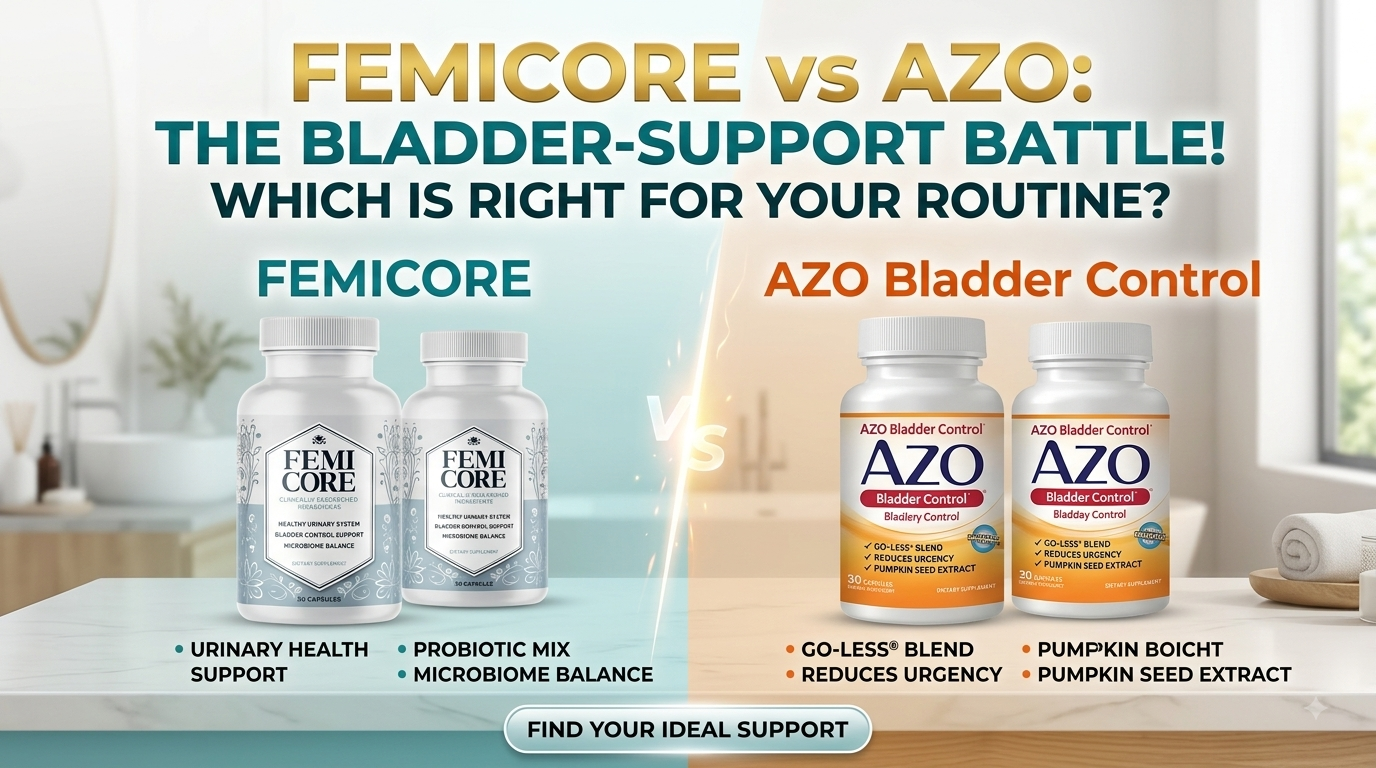
FemiCore vs AZO Bladder Control: Which Is Better for Women 40+?
FemiCore vs AZO Bladder Control: The Short Answer
If you are comparing FemiCore vs AZO Bladder Control, the biggest difference is their formula strategy.
AZO Bladder Control with Go-Less uses a relatively focused botanical approach built around pumpkin seed extract and soy germ extract. The manufacturer describes the product as supporting bladder control and helping reduce leakage and urgency.
FemiCore, based on the formula information provided for this comparison, takes a broader approach by combining four botanical ingredients—Mimosa Pudica, bearberry, cranberry extract, and berberine—with five Lactobacillus probiotic strains.
That does not automatically make FemiCore clinically superior to AZO. The better choice depends on what you want from a supplement, the ingredients you tolerate, your medications and health history, and whether your primary goal is general bladder support or broader urinary and microbiome support.
It is also important to understand that neither supplement should be treated as a substitute for medical evaluation of persistent urinary symptoms. The National Institute of Diabetes and Digestive and Kidney Diseases recommends discussing bladder-control problems with a healthcare professional because urinary leakage and urgency can have multiple causes.
Bottom line: FemiCore may be more appealing if you specifically want a multi-ingredient botanical-plus-probiotic formula. AZO Bladder Control may appeal more to shoppers who prefer a simpler, focused botanical formula.
Why Women Are Comparing FemiCore and AZO Bladder Control
For many women in their 40s, 50s, 60s, and beyond, bladder changes can become an unexpectedly frustrating part of everyday life.
Maybe you notice that you need to locate a restroom before going somewhere new.
Maybe laughing, coughing, exercising, or sneezing occasionally creates an uncomfortable moment.
Or perhaps nighttime bathroom trips have become more frequent.
These experiences are common, but they should not simply be dismissed as something every woman has to accept.
The NIDDK notes that bladder-control problems can involve accidental leakage or a sudden urge to urinate, and that childbirth, menopause, aging, and other health factors can contribute.
That is why women searching for FemiCore vs AZO Bladder Control are often looking beyond a simple product comparison. They want to know:
- Which formula is more comprehensive?
- Which ingredients are different?
- Which product is better for bladder support?
- Does either contain probiotics?
- What are the potential side effects?
- Which one is easier to take?
- Which option makes more sense for a woman over 40?
- Is one product actually proven to work better?
Those are the questions worth answering.
FemiCore vs AZO Bladder Control at a Glance
| Feature | FemiCore | AZO Bladder Control |
|---|---|---|
| Primary approach | Botanical + probiotic formula | Focused botanical formula |
| Bladder support | Yes | Yes |
| Cranberry | Yes | Not listed as the primary formula |
| Lactobacillus probiotics | Yes | No in the core formula described by AZO |
| Pumpkin seed extract | No | Yes |
| Soy germ extract | No | Yes |
| Multi-strain formula | Yes | No |
| Urinary microbiome emphasis | Stronger emphasis | More limited |
| Daily supplement | Yes | Yes |
| Best suited to | People seeking broader ingredient coverage | People preferring a simpler botanical approach |
The comparison above is based on the manufacturers’ published formula descriptions. It should not be interpreted as evidence that one product produces better clinical outcomes than the other.
What Is FemiCore?
FemiCore is marketed as a dietary supplement designed around women’s bladder and urinary wellness.
The formula supplied for this comparison contains nine components:
- Mimosa Pudica
- Bearberry
- Cranberry extract
- Berberine HCL
- Lactobacillus crispatus
- Lactobacillus acidophilus
- Lactobacillus casei
- Lactobacillus plantarum
- Lactobacillus gasseri
The interesting feature is the combination.
Instead of relying exclusively on one botanical, FemiCore combines several plant ingredients with multiple Lactobacillus strains.
That makes it particularly relevant to consumers interested in both bladder support and urinary microbiome wellness.
However, an important distinction is necessary: evidence for an individual ingredient does not automatically prove that the finished FemiCore product produces the same effect.
The amount, formulation, manufacturing process, strain characteristics, and clinical testing of the finished product all matter.
What Is AZO Bladder Control?
AZO Bladder Control with Go-Less is a dietary supplement specifically marketed for around-the-clock bladder support.
According to AZO’s product information, its formula uses pumpkin seed extract and soy germ extract. The manufacturer says pumpkin seed extract supports bladder control and normal function, while soy germ extract supports bladder and pelvic-floor control.
This gives AZO a very different formulation philosophy from FemiCore.
Rather than combining several botanical ingredients with multiple probiotic strains, the AZO product focuses on a smaller number of botanical components.
For shoppers, that creates a straightforward decision:
Do you prefer a more focused formula or a broader botanical-plus-probiotic formula?
FemiCore Ingredients vs AZO Ingredients
FemiCore: Four Botanical Ingredients
Mimosa Pudica
Mimosa Pudica is a botanical included in FemiCore’s formula.
Although it has a history of traditional use, consumers should be cautious about assuming traditional use equals clinical proof for bladder-control outcomes.
The strongest way to evaluate this ingredient is to distinguish between traditional use, laboratory research, human clinical trials, and evidence involving the finished supplement.
Bearberry
Bearberry, also known as uva ursi, contains naturally occurring compounds including arbutin.
It has a long history of traditional use associated with urinary health. However, traditional use should not be confused with proof that a modern supplement will prevent or treat urinary disease.
Women with kidney problems or other medical conditions should discuss herbal supplements with a healthcare professional before use.
Cranberry Extract
Cranberry is one of the more extensively studied ingredients in the urinary-health category.
The National Center for Complementary and Integrative Health reports that cranberry products may reduce the risk of recurrent symptomatic UTIs in some women, although research findings have been inconsistent. Importantly, cranberry is not a treatment for an existing UTI.
That distinction matters.
Cranberry may have a role in urinary wellness, but a woman experiencing burning, fever, blood in the urine, significant pain, or suspected infection should seek medical care rather than relying on a supplement.
Berberine HCL
Berberine is a plant-derived compound that has been studied for several aspects of metabolic and microbial health.
Its presence gives FemiCore another botanical component, but consumers should not assume that evidence for berberine in one health context proves effectiveness for bladder control.
FemiCore’s Probiotic Component
One of the biggest differences in the FemiCore vs AZO Bladder Control comparison is the inclusion of multiple Lactobacillus strains.
FemiCore contains:
- Lactobacillus crispatus
- Lactobacillus acidophilus
- Lactobacillus casei
- Lactobacillus plantarum
- Lactobacillus gasseri
The urinary and vaginal microbiome has become an important research area, particularly because Lactobacillus species can influence microbial ecosystems.
A systematic review published in Journal of Midwifery & Women’s Health examined probiotics for urogenital infections in women and found that the evidence was promising in some areas but heterogeneous, with differences in study quality and probiotic formulations.
More recent research also remains cautious. A 2026 systematic review of Lactobacillus-based interventions in postmenopausal women found that evidence for urinary outcomes was limited and heterogeneous, particularly for oral probiotic products.
That is an important point for responsible buyers:
Probiotic research is encouraging, but a probiotic ingredient should not automatically be interpreted as a clinically proven treatment for urinary incontinence.
AZO’s Pumpkin Seed and Soy Germ Formula
AZO takes a simpler approach.
Its Bladder Control with Go-Less product lists pumpkin seed extract and soy germ extract as its primary ingredients.
This can be attractive to women who prefer:
- A shorter ingredient list
- A botanical-focused formula
- Less emphasis on probiotics
- A product specifically positioned around bladder control
The advantage of simplicity is that it can make a product easier to understand.
The potential disadvantage is that someone specifically interested in probiotic or microbiome support may find the formula less aligned with their priorities.
Which Has the Better Formula?
There is no scientifically responsible way to say that FemiCore is universally better than AZO Bladder Control based solely on ingredient lists.
Instead, consider the objective.
Choose a broader formula if you prioritize:
- Multiple botanical ingredients
- Multi-strain Lactobacillus support
- Urinary microbiome considerations
- A combined botanical-and-probiotic approach
- Broader daily urinary wellness
Consider a simpler formula if you prioritize:
- Fewer primary ingredients
- Pumpkin seed extract
- Soy germ extract
- A focused bladder-support approach
- Avoiding probiotic supplements
This is a formula-fit decision, not a medical ranking.
FemiCore vs AZO for Women Over 40
Women over 40 deserve an additional layer of consideration because urinary symptoms can have different causes.
Menopause, pelvic-floor changes, childbirth history, medications, fluid intake, caffeine, constipation, infections, and other health conditions can influence urinary symptoms.
The NIDDK specifically notes that urinary incontinence has multiple potential causes and treatment approaches. Lifestyle changes, pelvic-floor approaches, medications, medical devices, and other treatments may be appropriate depending on the type and cause of incontinence.
That means a supplement should be considered as one part of a broader wellness strategy, rather than the entire strategy.
For example, someone experiencing stress incontinence after childbirth may require a different approach from someone experiencing sudden urgency associated with another condition.
FemiCore vs AZO: Side Effects and Safety
No supplement should be considered automatically safe simply because its ingredients are described as natural.
Possible reactions depend on the individual ingredient, dosage, medical history, allergies, medications, and personal tolerance.
With botanical and probiotic supplements, some consumers may experience digestive discomfort or other individual reactions.
Cranberry is generally considered safe when taken orally, but NCCIH notes potential stomach upset at high amounts and says evidence concerning cranberry and warfarin interaction is conflicting.
Anyone taking prescription medications should discuss a new supplement with a physician or pharmacist.
This is especially important for women managing:
Blood-thinning medications
Diabetes medications
Blood-pressure medications
Kidney conditions
Liver conditions
Chronic medical conditions
Pregnancy or breastfeeding
The FDA also advises consumers to talk with a healthcare professional before deciding to use dietary supplements because supplements can carry health risks and are not evaluated like prescription medicines.
Important: Supplements Are Not FDA-Approved Treatments
This distinction is frequently misunderstood online.
The FDA does not approve dietary supplements for safety and effectiveness before they are marketed in the same way it approves prescription drugs.
The FDA explains that supplement companies are responsible for ensuring their products are safe and that labeling complies with applicable requirements.
Therefore, claims such as “FDA-approved bladder supplement” should be viewed carefully.
A facility can be registered with the FDA, and manufacturers can follow good manufacturing practices, but that does not mean the FDA has approved a supplement as a treatment for urinary incontinence.
What About Cranberry and Urinary Health?
This is one area where FemiCore has an ingredient with a relatively substantial research history.
NCCIH reports that cranberry products may reduce the overall risk of symptomatic recurrent UTIs in some women, but the evidence is inconsistent. It also emphasizes that cranberry should not be used to treat an existing UTI.
This is particularly important for women who confuse:
bladder urgency ≠ UTI
and
urinary leakage ≠ UTI
They can occur together, but they are not interchangeable conditions.
Persistent or new urinary symptoms deserve appropriate evaluation.
Does Either Product Guarantee Better Bladder Control?
No.
A responsible comparison cannot promise that either FemiCore or AZO will eliminate leakage, stop frequent urination, or produce a specific result within a particular number of days.
Individual outcomes can vary considerably.
If you are considering a supplement, evaluate the product according to:
- Ingredient transparency
- Appropriate dosing information
- Manufacturing standards
- Potential medication interactions
- Your individual health circumstances
- The quality of evidence supporting the ingredients
- The company’s refund and customer-service policies
That approach is far more useful than choosing based solely on testimonials.
FemiCore vs AZO: Which Is More Convenient?
Both products are designed to be incorporated into a daily supplement routine.
Convenience ultimately depends on the specific package, serving instructions, and the consumer’s preferences.
FemiCore’s appeal is its combination of botanical and probiotic ingredients in a single formula.
AZO’s appeal is the relative simplicity of its botanical approach.
For someone already taking several supplements, the shorter ingredient profile may be attractive.
For someone who wants to combine botanical and probiotic support, FemiCore may be the more interesting option.
FemiCore vs AZO: Value and Buying Considerations
Price should not be the only factor.
Instead, compare cost per serving, ingredient quantity, serving instructions, shipping costs, refund terms, and whether you are buying directly from an authorized source.
AZO’s official product page currently lists package options for its Bladder Control with Go-Less product and identifies the product as a supplement containing pumpkin seed and soy germ extracts.
For FemiCore, check the current price and package options directly before purchasing because online supplement pricing can change.
Interested in reviewing FemiCore’s current formula and official purchasing information?
Visit the FemiCore Official Website
Review the current ingredient information, serving instructions, pricing, and guarantee directly before making a purchase.
Which One Should You Choose?
Here’s the simplest decision framework.
FemiCore may be worth considering if:
You want a multi-ingredient urinary wellness formula that combines botanical extracts with multiple Lactobacillus strains.
It may be particularly interesting if the urinary microbiome is an important part of what you are looking for in a daily supplement.
AZO Bladder Control may be worth considering if:
You prefer a more focused botanical formula centered on pumpkin seed and soy germ extracts and don’t specifically want a multi-strain probiotic supplement.
Neither should replace medical evaluation if:
You have persistent urinary leakage, sudden changes in urinary habits, pain, burning, fever, blood in the urine, recurrent infections, severe urgency, or symptoms that interfere significantly with daily life.
The NIDDK recommends speaking with a healthcare professional about bladder-control problems, and treatment can vary depending on the underlying type and cause.
FemiCore vs AZO Bladder Control: My Final Take
After looking at the two formulas from a consumer perspective, the biggest difference is not simply “which one is better.”
It is what type of formula you want.
AZO Bladder Control with Go-Less is the more straightforward option. Its formula centers on pumpkin seed and soy germ extracts, making it appealing to shoppers who want a focused botanical bladder-support product.
FemiCore takes a broader approach. Its formula combines Mimosa Pudica, bearberry, cranberry, berberine, and five Lactobacillus strains.
That broader formulation may appeal to women who want to address urinary wellness from both a botanical and microbiome perspective.
But broader does not automatically mean clinically better.
The evidence for individual ingredients and probiotics varies, and research on oral probiotics for urinary outcomes remains developing.
So, if your priority is a simple botanical formula, AZO may make more sense.
If your priority is a broader botanical-plus-probiotic approach, FemiCore may be the more relevant option to investigate.
Most importantly, don’t let an online comparison delay medical care when urinary symptoms are persistent or concerning.
Ready to explore FemiCore?
If the broader botanical-and-probiotic approach matches what you’re looking for, review the current formula, usage information, pricing, and purchase terms directly from the official source:
Explore FemiCore on the Official Website →
Frequently Asked Questions
Is FemiCore better than AZO Bladder Control?
Neither can be objectively declared better for every woman. FemiCore uses a broader botanical-plus-probiotic formula, while AZO Bladder Control with Go-Less uses pumpkin seed and soy germ extracts. The better fit depends on your individual goals and health circumstances.
What is the main difference between FemiCore and AZO Bladder Control?
The primary difference is the formulation. FemiCore combines four botanicals with five Lactobacillus probiotic strains. AZO Bladder Control with Go-Less uses pumpkin seed extract and soy germ extract as its core ingredients.
Does FemiCore contain probiotics?
Yes. The FemiCore formula described for this comparison contains five Lactobacillus strains: L. crispatus, L. acidophilus, L. casei, L. plantarum, and L. gasseri.
Does AZO Bladder Control contain cranberry?
The AZO Bladder Control with Go-Less formula referenced here lists pumpkin seed extract and soy germ extract as its primary ingredients rather than cranberry.
Can cranberry treat a UTI?
No. NCCIH states that cranberry products are not recommended as treatment for an existing UTI. Women with suspected UTI symptoms should seek appropriate medical care.
Can women over 50 use bladder-control supplements?
Age alone does not determine whether a supplement is appropriate. Women over 50 should consider their medications, medical conditions, allergies, kidney health, and the specific reason for their urinary symptoms. Discussing supplements with a healthcare professional is a sensible precaution.
Are FemiCore and AZO FDA-approved?
No dietary supplement should be described as FDA-approved for treating bladder problems. The FDA states that it does not approve dietary supplements for safety and effectiveness before marketing.
Should I use a supplement instead of seeing a doctor about bladder leakage?
No. Supplements should not replace medical evaluation. Bladder leakage and urgency can have multiple causes, and the appropriate treatment depends on the underlying problem.
Trusted Sources & Further Reading
- FDA — Dietary Supplements
Learn how dietary supplements are regulated in the United States and what FDA approval does—and does not—mean for supplements. FDA — Dietary Supplements - NIDDK — Bladder Control Problems
Read the National Institute of Diabetes and Digestive and Kidney Diseases’ information on urinary incontinence, bladder-control symptoms, causes, diagnosis, and treatment options. NIDDK — Bladder Control Problems - NCCIH — Cranberry: Usefulness and Safety
Review the evidence surrounding cranberry, recurrent UTIs, potential benefits, limitations, and safety considerations. NCCIH — Cranberry: Usefulness and Safety - PubMed — Probiotics for Treatment and Prevention of Urogenital Infections in Women
Explore a systematic review examining Lactobacillus-containing probiotics and their potential role in women’s urogenital health. PubMed — Probiotics and Urogenital Infections - PubMed — 2026 Probiotic Systematic Review for Recurrent UTIs
See the latest systematic-review evidence examining probiotic prophylaxis for recurrent uncomplicated urinary tract infections in adult women. PubMed — 2026 Probiotic Systematic Review - AZO — Bladder Control with Go-Less
Review the manufacturer’s information about AZO’s Go-Less bladder-control product and its positioning. For your comparison article, this is best used as a manufacturer source, not as independent clinical evidence.
Important editorial note: For the FemiCore vs. AZO article, don’t describe FDA registration or GMP manufacturing as equivalent to FDA approval of FemiCore. The FDA explicitly states that dietary supplements are not FDA-approved for safety or effectiveness before marketing.
Also, the 2026 PubMed review is worth citing carefully: it found promising evidence for probiotics in recurrent UTI prevention, but it involved only four randomized trials and substantial clinical heterogeneity. This makes wording such as “research suggests” or “may support” much safer and more credible than claiming that FemiCore itself has been clinically proven to prevent UTIs.
- FDA — Dietary Supplements
Medical & Consumer Disclaimer
This article is for educational and informational purposes only. It is not medical advice and does not diagnose, treat, cure, or prevent any disease. Dietary supplements are not substitutes for professional medical care. Speak with your physician or pharmacist before beginning a new supplement, particularly if you take prescription medications, are pregnant or breastfeeding, or have a medical condition.
Individual results may vary. Product formulations, pricing, serving recommendations, and availability can change, so verify current information with the manufacturer before purchasing.
Affiliate disclosure: This article may contain an affiliate link. If you purchase through a qualifying link, the publisher may receive a commission at no additional cost to you.