
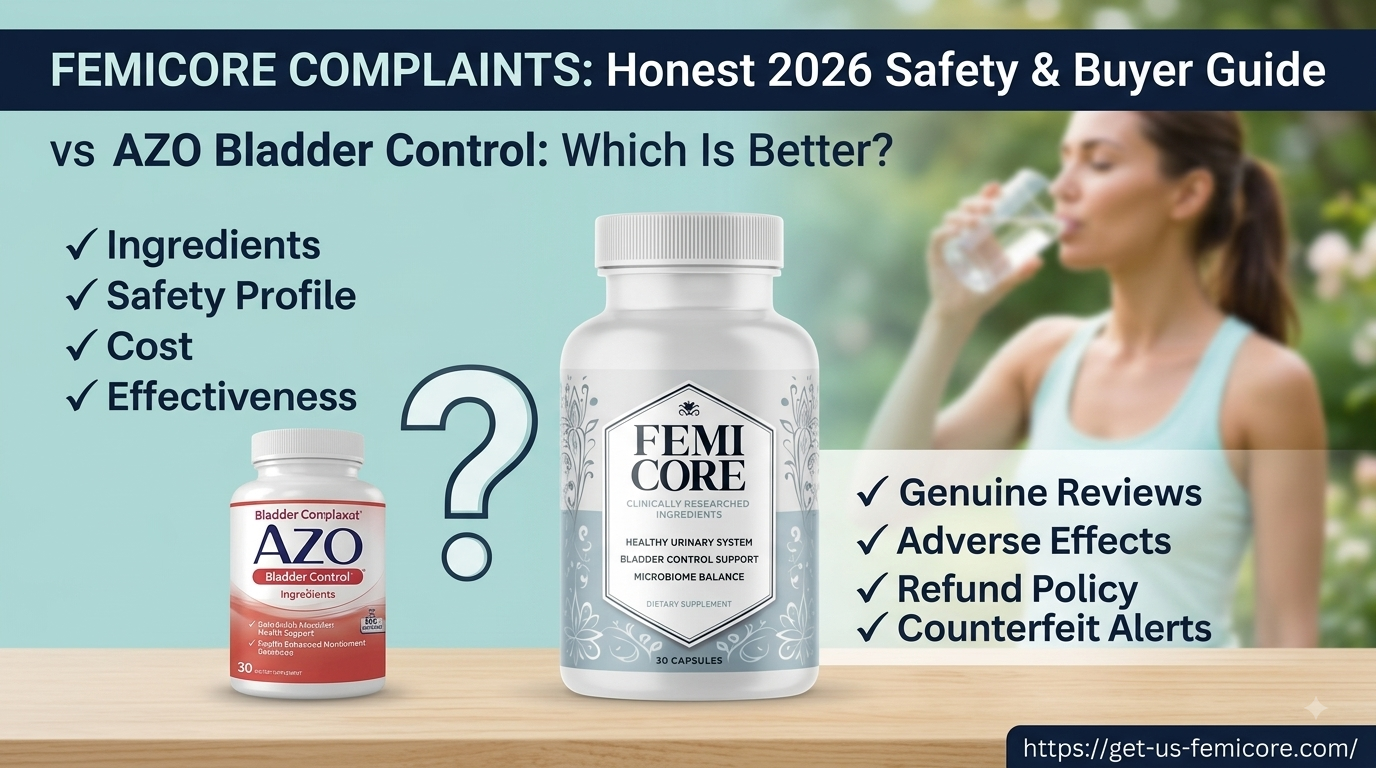
FemiCore Complaints: What Buyers Should Know Before Ordering
When women search for FemiCore complaints, they are usually asking a reasonable question: Are there genuine concerns I should know about before spending my money? A responsible answer requires more than repeating positive testimonials or labeling every negative experience a scam.
This guide examines the available information about FemiCore, its ingredients, manufacturing claims, customer feedback presented on its website, potential limitations, refund policy, and the broader science surrounding urinary wellness supplements.
The most important point is simple: FemiCore is a dietary supplement, not an FDA-approved treatment for urinary incontinence, urinary tract infections, or another medical condition. The FDA explains that dietary supplements generally do not undergo premarket approval for safety and effectiveness in the same way prescription drugs do.
So, are FemiCore complaints a reason to automatically avoid the product? Not necessarily. But there are legitimate questions buyers should investigate before making a decision.
FemiCore Complaints: Quick Answer
Are there FemiCore complaints? Individual dissatisfaction is possible with any supplement, particularly when expectations, tolerance, shipping, or perceived results differ from one customer to another. However, the information available to us does not establish that FemiCore has a systemic safety problem.
The bigger issue is that independent, product-specific clinical evidence and comprehensive independent complaint data are limited. That means consumers should distinguish between:
- A verified product-safety issue
- An individual customer complaint
- A complaint about shipping or customer service
- A complaint about price or expectations
- A lack of noticeable results
- A medically documented adverse event
Those are not the same thing.
FemiCore’s own website describes the product as a daily dietary supplement containing botanical extracts and multiple Lactobacillus probiotic strains. It states that the product is manufactured in the USA in an FDA-registered facility and under GMP-certified standards, and advertises a 60-day money-back guarantee.
Bottom line: prospective buyers should evaluate the label, ingredient evidence, safety considerations, purchasing terms, and realistic expectations rather than relying on a simple “good” or “bad” label.
What Is FemiCore?
FemiCore is marketed as a natural bladder and urinary wellness supplement for women.
According to the official product website, its formula combines four botanical ingredients with five probiotic strains:
- Mimosa Pudica
- Bearberry Leaf
- Cranberry Extract
- Berberine HCL
- Lactobacillus Crispatus
- Lactobacillus Acidophilus
- Lactobacillus Casei
- Lactobacillus Plantarum
- Lactobacillus Gasseri
The company’s positioning is focused on urinary wellness, bladder comfort, microbiome balance, and everyday feminine wellness rather than presenting FemiCore as a prescription medication.
That distinction matters.
A supplement can be designed to support normal wellness without being proven to diagnose, treat, cure, or prevent a medical condition.
If your symptoms include persistent urinary urgency, pain, blood in the urine, recurrent infections, sudden changes in bladder function, or significant leakage, a healthcare professional should evaluate the underlying cause rather than relying exclusively on a supplement.
Why Are People Searching for FemiCore Complaints?
There are several understandable reasons.
1. They want to know whether it actually works
Nobody wants to spend money on a supplement without understanding what evidence exists.
2. They are concerned about side effects
Natural does not automatically mean risk-free. Botanicals and probiotics can have biological effects, and some ingredients may interact with medications.
3. They want to know whether negative reviews are genuine
A customer saying “this didn’t work for me” is different from evidence showing a product is unsafe.
4. They want to understand the refund policy
A money-back guarantee can reduce financial risk, but buyers should still understand the exact terms before ordering.
5. They are concerned about purchasing the wrong product
Health-related products sold through multiple websites can create confusion about authenticity, pricing, and customer support.
These are all legitimate questions.
FemiCore Complaints: The Most Important Concerns to Investigate
Rather than inventing a list of unverified complaints, it is more useful to divide potential concerns into categories.
Complaint #1: “I Didn’t Notice the Results I Expected”
This is one of the most important limitations to understand with any dietary supplement.
FemiCore’s website says individual experiences may vary and describes the product as daily wellness support. It does not provide independent clinical evidence establishing that every customer will experience a particular degree of bladder improvement.
That means a buyer should avoid expecting:
- An overnight transformation
- Guaranteed elimination of leakage
- Guaranteed treatment of urinary conditions
- A predictable result after a specific number of days
A supplement’s ingredients may have scientific literature behind them, but that does not automatically prove that the finished FemiCore formulation produces the same outcomes.
That distinction is particularly important when evaluating health products.
Complaint #2: “The Ingredients Sound Promising, But Where Is the Product-Specific Clinical Trial?”
This is a fair question.
There is research involving individual ingredients and the female urinary microbiome, but that is different from conducting a randomized clinical trial on the exact FemiCore formulation.
Research into the female urinary microbiome is an evolving field. Peer-reviewed literature recognizes that urinary microbial communities exist and may be associated with conditions such as urinary urgency and other lower urinary tract symptoms, while also emphasizing that many questions remain unresolved.
A recent 2026 systematic review likewise found meaningful microbiome changes associated with genitourinary syndrome of menopause, but concluded that microbiome restoration alone does not necessarily predict symptom resolution.
Therefore, it would be misleading to take microbiome research and automatically conclude that FemiCore has clinically proven effects.
The evidence should be interpreted ingredient by ingredient and product by product.
FemiCore Ingredient Analysis
Mimosa Pudica
The FemiCore website identifies Mimosa Pudica as one of its botanical ingredients and positions it around urinary comfort and general wellness.
However, buyers should be careful about treating traditional botanical use as equivalent to modern clinical proof.
Traditional use can provide a reason for scientific investigation, but it does not establish that a particular supplement will produce a particular result.
Bearberry Leaf
Bearberry leaf, also known as uva ursi, is a traditional botanical associated with urinary wellness.
Its naturally occurring arbutin is one reason it has attracted attention in herbal medicine.
But this is precisely where responsible supplement evaluation becomes important.
Traditional use does not mean that every formulation containing bearberry is clinically proven for urinary symptoms.
Consumers should also consider the dose, duration of use, formulation, and individual health circumstances.
Cranberry Extract
Cranberry is probably the most familiar urinary-health ingredient in the FemiCore formula.
The FemiCore website says its cranberry extract is intended to support urinary wellness and describes proanthocyanidins as compounds involved in discouraging bacterial attachment.
However, cranberry should not be confused with a treatment for an active urinary tract infection.
If you have symptoms that could represent an infection, appropriate medical assessment is more important than trying to self-treat with a supplement.
Berberine HCL
Berberine deserves particular attention because it is biologically active and can interact with medications.
The NCCIH reports that studies have associated berberine with gastrointestinal effects including nausea, abdominal pain, bloating, constipation, and diarrhea. It also notes that berberine can interact with medicines.
That makes medication review especially important.
If you’re taking prescription medications, don’t assume that a “natural” supplement is automatically compatible with them.
What About the Probiotic Strains?
FemiCore contains several Lactobacillus strains:
- Lactobacillus crispatus
- Lactobacillus acidophilus
- Lactobacillus casei
- Lactobacillus plantarum
- Lactobacillus gasseri
This is an interesting part of the formula because research increasingly recognizes the importance of microbial communities in female urinary and reproductive health.
But there’s an important caveat.
The existence of an association between microbiome composition and urinary health doesn’t prove that taking a particular oral probiotic formulation will correct urinary symptoms.
Researchers are still working to understand these relationships.
One review notes that the specific role of the female urinary microbiota remains unclear and requires additional research.
Another recent review describes microbiome-based interventions as an emerging area while emphasizing that efficacy remains limited by incomplete understanding of host-microbiome interactions.
That’s a much more accurate interpretation than saying probiotics “fix” bladder problems.
Can FemiCore Cause Side Effects?
Potential side effects depend partly on the individual ingredients and the person taking them.
For example, probiotics are generally well tolerated by many healthy people, but the NCCIH notes that detailed safety data are limited and that risks can be greater in people who are seriously ill or immunocompromised.
Possible issues with a multi-ingredient supplement can include:
- Digestive discomfort
- Bloating
- Changes in bowel habits
- Individual ingredient sensitivity
- Allergic reactions
- Medication interactions
This does not mean that FemiCore will cause these effects.
It means consumers should understand that “natural” isn’t synonymous with “zero risk.”
FemiCore and Prescription Medications
This is an area where caution is more important than marketing.
The official FemiCore website specifically advises people taking certain prescription medications to seek medical guidance before using the product. It also advises pregnant or breastfeeding women and people with medical conditions to consult a healthcare professional.
The FDA similarly advises consumers to speak with a doctor, pharmacist, or other healthcare professional before using dietary supplements because some supplements can interact with medications or other supplements.
If you take several medications, particularly medications with a narrow therapeutic range, bring the complete FemiCore ingredient label to your pharmacist or doctor.
That’s a far better safety strategy than relying on online comments.
Are FemiCore Complaints Evidence That It Is a Scam?
No—not by themselves.
A complaint doesn’t automatically establish fraud.
For example:
“I didn’t experience the result I expected.”
That’s a customer-experience complaint.
Compare that with:
“Laboratory testing showed the product contained a dangerous undeclared ingredient.”
That’s a substantially different allegation requiring evidence.
Similarly:
“Shipping took longer than expected.”
is different from:
“The company refused to honor its published refund policy.”
When researching FemiCore complaints, buyers should identify what type of complaint they’re actually reading.
This prevents an emotional review from being mistaken for evidence of a systemic safety problem.
What Does the Official FemiCore Website Say?
The official website states that FemiCore is:
- Made in the USA
- Manufactured in an FDA-registered facility
- Produced under GMP-certified standards
- Non-GMO
- Gluten-free
- Designed as a once-daily wellness formula
- Backed by a 60-day money-back guarantee
These are company-provided claims, not independent certification findings that we have separately verified.
That distinction is important for trustworthy publishing.
What does “FDA-registered facility” mean?
It does not mean “FDA-approved supplement.”
The FDA explicitly states that it does not approve dietary supplements for safety and effectiveness before they are marketed.
Therefore, readers should not interpret an “FDA-registered facility” statement as evidence that the FDA has clinically approved FemiCore.
FemiCore Complaints About Manufacturing Claims
Manufacturing transparency is worth examining whenever you buy a supplement.
A GMP claim can be useful because current good manufacturing practices are designed to help ensure products are produced consistently and meet quality requirements.
However, “GMP certified” and “FDA approved” should never be treated as interchangeable phrases.
The FDA explains that supplement manufacturers and distributors are responsible for ensuring their products meet applicable safety and labeling requirements, while FDA oversight is largely post-market.
That’s why consumers should focus on:
- Supplement Facts
- Ingredient quantities
- Serving size
- Manufacturer/distributor information
- Lot information where available
- Storage instructions
- Expiration information
- Return terms
FemiCore Customer Reviews: What Can They Tell You?
The official FemiCore website displays customer stories from women identified as Jessica, Ashley, and Rebecca, with ages and U.S. locations. The experiences described are centered on comfort, confidence, routine, and lifestyle rather than claiming a medical cure.
These testimonials may help prospective customers understand how some users describe their experience.
But they shouldn’t be treated as clinical evidence.
The FTC specifically warns that health-product testimonials cannot be used to communicate claims that would require scientific substantiation if the advertiser made those claims directly.
So a responsible reader should ask:
Is this a personal experience, or is this evidence that most people will experience the same result?
Those are very different questions.
What If a Customer Complains That FemiCore Didn’t Work?
That’s possible with virtually any wellness product.
Individual outcomes can vary because urinary symptoms have many potential causes.
For example, urinary urgency or leakage can be associated with factors such as:
- Age
- Pregnancy and childbirth history
- Menopause
- Pelvic-floor changes
- Overactive bladder
- Urinary infection
- Certain medications
- Neurological conditions
- Other underlying medical issues
A supplement cannot reasonably be expected to address every possible cause.
That’s why persistent or worsening symptoms deserve professional evaluation.
When Should You Talk to a Doctor?
Don’t use FemiCore—or any supplement—as a substitute for medical evaluation when symptoms could indicate a medical problem.
Seek medical advice if you experience:
- Blood in your urine
- Fever or chills
- Significant pain
- Burning urination
- Sudden major changes in urinary function
- Recurrent urinary infections
- Severe pelvic or abdominal pain
- New urinary symptoms accompanied by neurological changes
- Symptoms that persist or worsen
The goal isn’t to discourage responsible supplement use.
It’s to make sure a supplement doesn’t delay diagnosis of something that needs medical attention.
FemiCore Complaints About Price and Value
Another common source of dissatisfaction with supplements is value.
A customer may be satisfied with the ingredients but still decide that the product is too expensive for their budget.
That’s not necessarily a product-quality complaint.
Before purchasing, calculate:
Cost per bottle × expected duration of use = approximate total cost.
Also check:
- Shipping charges
- Package size
- Whether discounts apply only to multi-bottle purchases
- Whether bonuses are included
- Refund requirements
- Customer-support contact information
- Whether recurring billing is involved
The official FemiCore website currently advertises a 60-day money-back guarantee, but buyers should review the current terms at the time of purchase rather than relying on an old screenshot or third-party article.
Is the FemiCore Money-Back Guarantee Real?
The official site states that customers can contact support within the guarantee period for refund information and describes a 60-day money-back guarantee.
That can reduce financial risk, but a guarantee should not be interpreted as evidence that a product is medically effective.
A refund policy answers one question:
“What happens if I’m dissatisfied with my purchase?”
It does not answer:
“Does this product clinically treat my symptoms?”
Those are separate issues.
How to Buy FemiCore More Safely
If you’ve decided to investigate FemiCore further, use basic online-purchase precautions.
1. Check the product label
Don’t rely solely on advertisements.
2. Verify the ingredient list
Look for the current Supplement Facts panel and serving information.
3. Check the return policy
Read the current policy before ordering.
4. Avoid suspiciously discounted listings
Extreme discounts can be a warning sign with any branded product.
5. Use the official product source
For the current product information, pricing and purchasing options, visit the FemiCore Official Website.
6. Speak with your pharmacist if you take medications
This is especially important when using multi-ingredient supplements. FDA specifically recommends discussing supplements with a healthcare professional because interactions can occur.
Is FemiCore Right for You?
FemiCore may be worth researching if you’re an adult interested in a daily supplement focused on urinary wellness and microbiome support.
It may be less appropriate to rely on it as your primary strategy if:
- You have an active urinary infection
- You’re experiencing unexplained bleeding
- You have serious kidney disease
- You’re pregnant or breastfeeding without medical guidance
- You’re taking medications that may interact with the ingredients
- You expect an immediate medical result
- You need treatment for a diagnosed condition
The official product site itself recommends medical consultation in several of these situations.
What Makes FemiCore Different?
The main distinguishing feature of the formula is its combination of botanical extracts and multiple Lactobacillus strains.
The official formulation contains cranberry, bearberry, Mimosa Pudica and berberine alongside five Lactobacillus strains.
That gives the product a broader wellness positioning than a single-ingredient supplement.
However, “more ingredients” doesn’t automatically mean “better.”
For supplements, formulation quality, ingredient amounts, individual tolerance, evidence and suitability are all important.
A 2024 review of the urinary microbiome emphasizes that relationships between microbiota and urinary health are biologically interesting but remain an area requiring further research.
The Biggest FemiCore Limitation Buyers Should Know
The biggest limitation isn’t necessarily a particular complaint.
It’s the gap between ingredient research and product-specific clinical evidence.
You can find scientific studies about cranberry.
You can find research about probiotics.
You can find research exploring the urinary microbiome.
You can find literature about individual botanical compounds.
But those studies should not automatically be presented as clinical proof that the finished FemiCore product will produce a particular outcome.
That is the line responsible health content should maintain.
FemiCore Complaints: My Overall Assessment
After separating the available information into product claims, ingredient evidence, consumer experience and regulatory context, the picture is more nuanced than either extreme.
What appears reasonable
FemiCore is presented as a dietary supplement with a clearly described ingredient formula, a urinary-wellness positioning, multiple probiotic strains, and a published money-back guarantee.
What deserves caution
The FDA does not preapprove dietary supplements for safety and effectiveness, and the existence of research on individual ingredients does not establish clinical effectiveness of the finished FemiCore formula.
What buyers should not assume
Don’t assume:
- Natural means risk-free.
- FDA registration means FDA approval.
- A testimonial proves effectiveness.
- A negative review proves a product is dangerous.
- An ingredient study proves the entire formula works.
- A money-back guarantee proves medical effectiveness.
Those distinctions make a much more useful buying decision.
Final Verdict: Should You Be Concerned About FemiCore Complaints?
FemiCore complaints should be investigated, but they should not be interpreted without context.
The available information does not allow us to conclude that FemiCore is inherently unsafe or that every customer will benefit from it. At the same time, there isn’t enough independent product-specific clinical evidence to promise that FemiCore will solve bladder or urinary problems.
For women considering the product, the sensible approach is to evaluate the actual ingredient label, understand potential interactions, maintain realistic expectations, review the refund terms, and discuss the supplement with a qualified healthcare professional when appropriate.
If you’re comfortable with those limitations and want to review the manufacturer’s current formulation, purchasing information and guarantee, you can visit the FemiCore Official Website.
The most important takeaway is this:
A responsible FemiCore buying decision isn’t about believing every positive testimonial or every negative complaint. It’s about understanding what is known, what isn’t known, and whether the product fits your individual circumstances.
Frequently Asked Questions About FemiCore Complaints
Is FemiCore a scam?
There is not enough evidence to conclude that FemiCore is a scam simply because online searches contain complaints. Complaints can involve effectiveness, expectations, shipping, pricing, or individual tolerance. Those categories should be investigated separately.
Are there negative FemiCore reviews?
Individual negative experiences can occur with dietary supplements. However, a negative review by itself does not establish that a product is unsafe or fraudulent.
What are the most common FemiCore complaints?
Potential concerns include dissatisfaction with results, individual ingredient tolerance, pricing, shipping, or expectations. Product-specific complaint data should be verified rather than invented or generalized from isolated comments.
Does FemiCore have side effects?
Potential reactions depend on the individual and ingredients. Berberine, for example, has been associated with gastrointestinal symptoms in research, while probiotic safety varies according to individual health status.
Can I take FemiCore with prescription medications?
You should ask your doctor or pharmacist before combining FemiCore with prescription medication. FDA specifically recommends discussing dietary supplements with healthcare professionals because interactions can occur.
Is FemiCore FDA approved?
No dietary supplement should be described as FDA-approved simply because it is manufactured in an FDA-registered facility. FDA states that it does not approve dietary supplements for safety and effectiveness before marketing.
Does FemiCore treat urinary incontinence?
FemiCore is marketed as a dietary supplement for urinary and bladder wellness. It should not be represented as a proven treatment or cure for urinary incontinence or another medical condition.
Does FemiCore offer a money-back guarantee?
The official website currently states that FemiCore offers a 60-day money-back guarantee. Buyers should review the current refund terms before ordering.
Where can I find the current FemiCore ingredients?
The current ingredient information is available on the official product website. The listed formula includes four botanicals and five Lactobacillus probiotic strains.
Where should I buy FemiCore?
For the current formulation, pricing and purchasing information, use the official FemiCore website rather than relying on an unknown third-party seller.
Independent Sources & Further Reading
For readers who want to investigate the science and regulatory context themselves:
- FDA — Dietary Supplements: The FDA explains how dietary supplements are regulated and why they are not generally preapproved for safety and effectiveness.
- NCCIH — Probiotics: Information about probiotic usefulness, safety and potential risks.
- NCCIH — Berberine: Evidence and safety information concerning berberine, including gastrointestinal effects and drug interactions.
- PubMed — Female Urinary Microbiome: Peer-reviewed research examining the relationship between urinary microbiota and women’s urinary health.
- FTC — Health Products Compliance Guidance: Guidance concerning evidence, testimonials and health-related advertising claims.
Get an In-depth & well Researched Honest Review
Final Health Disclaimer
FemiCore is a dietary supplement and is not intended to diagnose, treat, cure, or prevent any disease. Individual results may vary. Consult a qualified healthcare professional before using any dietary supplement, particularly if you are pregnant or breastfeeding, have an existing medical condition, or take prescription medications. If you have persistent, painful, severe, or unexplained urinary symptoms, seek appropriate medical care rather than relying solely on a supplement.